Categories
Blog

Top Articles of 2025

Recapping our Top Articles from 2025

As we enter the new year, let’s recap our top articles from 2025!

ArcLab’s approach to learning and development centres around the principal of effective mobile and nano learning, specifically tailored for the deskless and frontline workforce. Good digital learning must be mobile-first, bite-sized (10-15 minutes per module), and available on-demand to seamlessly integrate training into the flow of work. These articles focus on strategies and tips that L&D managers can implement to create effective workplace modules, and enhance overall learning experiences for their staff.

1. 9 Best Practices for Creating Effective Digital Learning Experiences

We’ve all been there – staring down at a massive training document, wondering how to turn it into something your learners will actually absorb. In today’s fast-paced business world, effective digital learning is more than a checkbox – it’s the key driving force for organisational productivity and competitiveness. Last year, ArcLab hosted a User Clinic inviting Martin Goh, a consultant from Deloitte Learning Solutions as the guest speaker, who shared his ultimate guide and tips (tried & tested!) for L&D success.

The sharing follows a systematic guide: always start by identifying the core business problem and tailoring the solution to your specific audience. Once you’re in the design phase, prioritise a value-first approach, use compelling content hooks, and follow the 10-15 minutes rule to ensure content is digestible. Incorporate real-world scenarios and ensure your assessments perfectly match learning goals. Finally, don’t overlook the User Experience (UX) and remember that genuine engagement goes beyond surface-level interactivity; make continuous improvement a habit by routinely collecting feedback!

Read it again here

ArcLab User Clinic 2025

2. Your Guide to Creating Better Training Materials

Don’t let the pressure of constantly creating fresh, engaging training content weigh you down! This guide from ArcLab dives into how you can strategically leverage GenAI significantly elevate your module creation process without sacrificing quality.

Think of GenAI as a collaborative assistant (not a replacement) that handles the heavy lifting, from brainstorming initial module outlines to summarising dense material into mobile-friendly chunks, and even creating assessment questions. The secret to success lies in mastering effective prompts: be specific, provide relevant context, and be ready to refine the output until it’s perfect. When you pair this AI-assisted content creation with a robust assessment strategy—using diverse formats like MCQs, open-ended questions, and interactive screens—you empower L&D managers to produce quality learning modules that truly enhance workforce performance.

Read all about it (and get your free guide to prompt writing) here!

ArcLab SmartTransform® document upload feature

3. Anti-cheating in the Workpalce

As digital training becomes the norm, L&D managers are facing a growing challenge: ensuring employees genuinely learn and don’t resort to cheating, which can undermine training effectiveness and even compromise workplace safety.

The solution isn’t just advanced software, but a strategic combination of ethical culture and smart assessment design. Implement monitoring protocols like in-person invigilation to deter misconduct, and most critically, design meaningful assessments that require application and critical thinking over simple recall. Leverage ArcLab’s platform features like question randomisation, diverse assessment types (MCQs, open-ended, reorder), and set strict time limits. By consistently refreshing questions and focusing on high-stakes skills assessments rather than low-stakes memorisation, companies can foster a culture of integrity and ensure genuine, effective learning.

Read it again here

Thank you for reading!

We’re preparing for 2026 with even more robust resources and exciting new platform features.

We are committed providing our customers with the business tools to make workforce upskilling fast and frictionless. We trust that our articles and resources will continue to be invaluable to you as you enhance your organisation’s productivity.

Cheers to a successful 2026!

Categories
Blog

Your Guide to Creating Better Training Materials

Module Creation with GenAI

Generative AI (GenAI) is quickly becoming an indispensable tool for L&D managers, offering an effective and cost-saving way to meet the ever-increasing demand for fresh, engaging training content. This guide will show you how to strategically leverage GenAI to elevate and accelerate your content creation without sacrificing quality. 

Practical Tips on Using GenAI to Create Training Materials for your Workforce

Think of GenAI as your collaborative assistant, not a replacement – use it to handle the heavy lifting, while you focus on AI-proof tasks like strategic design and enhancing overall learner experience. 

1. Brainstorming and outlining: Not sure where to start when creating a module or simply facing a writer’s/creative block? Use GenAI to generate an outline for a specific topic or learning objective. It is important to that the prompt given is clear and specific to optimise the results generated.

Prompt example: “Create a learning module outline for F&B staff on excellent customer service. Focus on handling complaints, appropriate behaviour, and upselling techniques. Include learning content, case studies and assessment questions.”  We will cover the tips on writing effective prompts in the next section.

2. The first draft: Once you have the outline or main points, feed it back to GenAI to generate information that substantiates, elaborates and expands on each point. This extra information generated can be used as explanations, case studies or examples, saving you a significant amount of time taken for research and development.

Prompt example: “Expand and elaborate on the point: De-escalating a complaint about an unsatisfactory customer experience. Include the necessary steps to take and provide a short scenario-based case study.”

3. Summarise and condense content: Alternatively, if you have existing lengthy training materials, use GenAI to repurpose the information by summarising key learning points and concepts into bite-sized, mobile-friendly chunks. This is especially applicable to mobile learning platforms like ArcLab, with AI-assisted features like ArcLab SmartTransform®. This feature allows users to upload an existing training document (supports all major file types) to create an entire training module in a matter of seconds. 

ArcLab SmartTransform® document upload feature

4. Generate case studies and scenarios: To reinforce learning concepts, use GenAI to generate plausible examples tailored to specific roles and the corresponding “dos & don’ts”. Furthermore, to foster critical thinking and problem-solving skills, use GenAI to research and generate relevant case studies.

5. Generating assessment Q&A: Of course, scenario-based learning is insufficient to support all rounded learning. Use GenAI to generate relevant quiz questions using various assessment methods based on the content covered. We will cover the use of appropriate assessment screens in section 3 of this blog. 

Tips on Effective Prompt Writing

The quality and accuracy of the GenAI output is dependent on the quality of your input. To ensure satisfactory generated results, it is important to grasp the strategies to write an effective prompt.  

1. Be specific and clear: Be clear and concise when stating the learning objective, topic, target audience and format. Remember – the more vague your prompt is, the more generic the results will be.

Prompt example: “Create a module to train (learning objective) my on-site construction workers (target audience) on safety measures and protocols to observe when working at heights (topic). Include learning content, case studies and assessment questions (format).”

2. Give relevant context and limitations: If possible, reference existing material to provide the AI with background context, so that more personalised and relatable content can be generated. This information can come from your company’s website, industry-specific guidelines/regulations, or a role-specific job description.

Prompt example: “With reference to Workplace Safety and Health (Work at Heights) Regulations 2013 enforced by MOM (context), provide a bullet-point list (format) of the necessary guidelines and measures for construction workers to adhere to.

3. Refine: Satisfactory results may not be delivered on the first attempt. Use GenAi’s output as a first draft, then prompt the AI for further elaborations and amendments. Be specific about the areas that you want to revise as well!

Prompt example: “Elaborate on the steps taken by a F&B staff to de-escalate a customer complaint about an unsatisfactory meal. Give a scenario and include the appropriate response to be taken.”

Using Appropriate Assessment Screens

Good learning content contributes to only half of an effective learning module. The assessment component is essential to ensure that your learners understand the material covered. Here are various assessment screen types (used for different assessment goals and methods), and how ArcLab supports them:  

1. MCQs/ True or False Questions: Quick checks for comprehension on basic concepts. ArcLab MCQs screen consists of various customisable settings such as – display media, time limit, number of options, randomise options, question type (quiz/ poll), and answer explanations. 

Prompt example: “Generate a multiple choice question with one correct answer and three plausible distractors based on this concept.”  

ArcLab MCQ quiz settings

2. Open-ended/ Short Answer Questions: Encourages critical thinking and elicit detailed responses from learners that provide deeper insights on their level of understanding. ArcLab’s auto-grading feature allows the system to grade learners’ responses based on the correct/incorrect/alternative keywords input by the learning designer. This reduces the need and time taken for manual grading. 

ArcLab OEQ's auto grading feature

3. Interactive drag-and-drop: Applicable for visual learners. ArcLab’s Reoerder screen assessment reinforces sequence-based learning, while the Unscramble screen adds a fun twist to test learners on key words. Try it out for yourself! 

ArcLab's Reorder screen

Gen-AI should not replace the work of L&D managers.  But rather, when used strategically, assist them in creating more engaging and relevant learning modules. By leveraging on GenAI’s potential, accompanied by powerful AI-assisted features on ArcLab’s module creation platform, L&D managers can produce quality learning content and enhance overall performance of the workforce.

Download your free guide on Writing Effective Prompts

Download this FREE one-pager guide to find out more about how to write effective prompts using GenAI. 

Categories
Blog

ArcLab 2025 Round up

The AI Advantage

2025 was a productive year in developing ArcLab’s Generative Artificial Intelligence (GenAI) features. GenAI has revolutionised the creation process of training content, significantly boosting efficiency and personalisation. These tools can automate tedious and time-consuming tasks like drafting learning modules, generating assessment questions, and summarising large amounts of training content, allowing L&D managers to focus on other in-person tasks. Furthermore, L&D managers can use AI to tailor learning content to individual learner needs and the organisation’s training goals.

This results in more efficient training creation process, and more engaging, relevant and effective training programmes.

Image from Unsplash

ArcLab 2025 Round Up

Here’s a quick recap of the features that we have enhanced and launched in this past year 🚀

SmartTransform® AI Reloaded – GenAI for training Creation

Increase your training curation & creation output and efficiency!

With ArcLab SmartTransform® AI, you can create modules and quizzes instantly by uploading an existing SOP document or training manual (all major file types are supported), and entering a prompt (just like you would in ChatGPT or Gemini).

Check out our step-by-step guide here

ArcLab SmartTransform®

SmartTranslate™ AI Reloaded – Create Multi-language Training

Let your learners consume training in the language(s) they know best!

ArcLab SmartTranslate™ AI empowers you to automatically translate your modules and Question Bank MCQs (new feature for ArcLab Pro customers only) into any language in a matter of seconds. This allows learners to consume training in their native languages, breaking down any language barriers that may hinder effective training. 

Check out our SmartTranslate step-by-step guideere, and a sample module.

ArcLab SmartTranslate™

SmartMedia AI – Create Training Media in seconds

A picture paints a thousand words!

ArcLab SmartMedia lets you create contextually-appropriate media for your training modules with a simple prompt. No more expensive photoshoots or cutting & pasting from other apps. Prompt directly in ArcLab and iterate the media such that it best fits your learners. 

Learn more about SmartMedia here

ArcLab SmartMedia™

SmartVoice AI – Text-To-Speech / Voiceovers

ArcLab SmartVoice AI is our newest feature that also increases your training’s accessibility and inclusivity.

Our text-to-speech voiceover function auto-generates any module text into audio narrations, allowing auditory learners to consumer training content more effectively. Equipped with several toggle functions (speed, repetition, etc.), SmartVoice allows leaners to consume training at their own pace as well. 

Learn more about SmartVoice here

ArcLab SmartVoice

Collaboration and Efficiency

ArcLab Pro+ Shared Workspace

Another feature that we introduced exclusively for our ArcLab Pro customers is ArcLab Pro+.

Think of it as a Google Drive / Microsoft OneDrive equivalent.  ArcLab Pro+ is a collaborative platform that serves as a shared workspace, allowing multiple Builders within an organisation to jointly develop and administer ArcLab modules and manage a common pool of learners.

The primary purpose of Pro+ is to optimise subscription costs through centralised management while simultaneously decentralising the actual creation of training content and learner administration across different internal teams.

ArcLab Pro+ is also a much more secure way of collaboration within the organisation, compared with sharing one login and password across several Builders (this is very poor cybersecurity practice!)

Learn more about ArcLab Pro+ here

ArcLab Pro Plus

Automated Learner Reminders

Automate module completion reminders for your learners (available for ArcLab Pro customers only) using ArcLab’s platform. This saves you the effort of manually following up on learners that have yet to complete their assigned modules. You can set the reminders for individual modules or entire folders, and customise the time intervals/ repetition of the reminders.

Check out our step-by-step guide here

Setting up reminders for individual modules

Lastly, we would like to round off 2025 by extending our deepest gratitude to you. We are incredibly proud to support your training goals and look forward to continue building the best tools for you.

We wish you a joyous holiday season and a prosperous New Year!

Sincerely,

The ArcLab Team 

Categories
Discover Learning Library (NEW!) Workplace Safety & Health

Work Injury Compensation Act (WICA)- Making Fraudulent Claims

Educate your staff on their WICA claim eligibility, benefits, and the severe penalties for making fraudulent claims.

Languages: English, Chinese, Bahasa, Tamil, Filipino, Indonesian, Burmese, Thai, Vietnamese. Add your own language selection with SmartTranslate™️

Categories
Blog

Anti-cheating in the workplace

Anti-cheating in the workplace

Cheating among learners in workplaces has become a growing concern, especially as organisations adopt digital training approach and initiatives. While workplace learning is designed to foster growth and development of employees, some employees may choose to resort to dishonest and unethical work practices such as copying of answers, or having others complete the assessment for them instead. These behaviours can in turn compromise the effectiveness of such training programmes, leading to poor on-site workplace performance, and in more serious cases, breaches of safety. Hence, addressing such complications requires proper measures to be put in place.  

Companies can implement a combination of policies as well as cultural and ethics strategies to counter or minimise cheating among learners in digital workplace training environments. 

1. Assessment protocols and monitoring system 

In-person invigilation or setting up of webcams (or CCTVs) can be implemented during assessments in a controlled environment to deter any misconduct among learners. This also provides evidence if any misconduct or cheating is suspected.

2. Fostering a culture of integrity in the workforce 

Often times, employees behaviours, culture and values are cultivated from Day 1 of joining the company. Hence, it is important to encourage employees to take accountability and be in charge of their own learning and growth, and practice honesty even when carrying out daily tasks. 

3. Diverse assessment types and design  

As L&D managers, another way and the most effective way to deter cheating among learners is through assessment design. With the diverse number of mobile training platforms available, relying on good instructional design and leveraging its built-in features are essential, rather than opting for advanced protocol softwares.

ArcLab, is one of such platforms for mobile and nano learning. While it offers assessment features, it is not primarily marketed as a high-stakes exam protocoling tool. Below are some ways in which L&D managers can successfully utilise ArcLab by combining its features with general best practices for online assessments. 

Leveraging ArcLab's features

Diverse Assessment Types 

ArcLab offers various assessment screens, including: 

  • Multiple Choice Questions
  • Multiple Select Questions
  • Open-Ended Questions
  • Reorder questions
  • Word Unscramble 

Using a mix and putting a timer on the questions can make it more challenging for learners share or copy answers with each other.

Question Bank and Randomization (for MCQs)

ArcLab has a Question Bank feature for Multiple Choice Questions. This allows you to:

  • Bulk upload a set of different MCQs.
  • Serve different questions to different learners. This is a key anti-cheating measure, as it allows each learner to have their own unique test version.

NanoCredentials

ArcLab allows you to award digital achievement badges (NanoCredentials) for completed modules. While this does not serve directly as an anti-cheat measure, it can be part of a broader strategy to encourage ernest learning and achievement.

Geofencing

ArcLab offers geofencing capabilities to restrict module access to specific locations. This can be useful for in-person training or assessments as it ensures that learners are present in a specific physical area to access the content or complete an assessment.

Secure Access

ArcLab modules are accessed through unique logins automatically-generated by the platform, which helps ensure that only authorised learners can participate.

Learner Analytics 

The Learner Analytics Dashboard can help you track learner progress and effectiveness. While not a direct cheating detection tool as well, it can be used to detect inconsistent progress, similar responses or unusual completion times, which can in turn raise flags for further investigation.

General best practices & tips

Design Meaningful Assessments

  • Questions should focus on application, not just recall/facts: Instead solely relying on memorisation, formulate questions that demand critical thinking, problem-solving, and application of knowledge and concepts. Questions that require situational analysis or individual viewpoints and responses are harder to cheat on.
  • Open-Ended Questions: These are more difficult to cheat on with simple copy/paste methods or pre-written answers.
  • Personalised Questions: Wherever deemed suitable, tailor questions to learners’ personal experiences or ask questions that apply to their specific job scope.
  • Vary Question Order and Answer Choices: Even without an exclusive feature for randomising questions, manually shuffling the question and answer options order across different versions of a module can deter cheating and copying of answers. 
  • Frequent, Low-Stakes Assessments: Instead of one high-stakes exam, assessments can be split up into various frequent, smaller quizzes. Low-stakes assessments generally reduces the pressure on the learner to cheat on any assessment.

Time Management

  • Set Time Limits: Set reasonable time limits on questions to prevent learners from having sufficient time to search for answers online or discuss with one another. 

Content Security

  • Regularly Update Questions: Avoid recycling the same questions over various learner groups. It is important to regularly refresh the question bank so that each group of learner gets a new set of questions.
  • Avoid Publicly-Available Answers: Avoid using questions and answers that readily accessible from the internet or online forums. Instead, tailor the questions to your specific company or industry. 

It is essential to put measures in place that encourages honesty in the workplace, especially as business are becoming more and more reliant on digital training. By enforcing general best practices while leveraging on ArcLab’s features, companies will be able to create a learning environment for effective and genuine learning. 

Categories
Blog

9 Best Practices for Creating Effective Digital Learning Experiences

In early April, ArcLab hosted our first User Clinic of 2025, with Martin Goh, consultant at Deloitte Learning Solutions as our esteemed guest speaker. Martin delivered an insightful session on best practices for creating effective digital learning, drawing from his extensive experience in the field. The webinar brought together L&D managers, industry trainers and leaders from across multiple countries. In addition to the valuable sharing session, Martin was joined by ArcLab’s CEO, James Chia, for a thought-provoking Q&A session that sparked meaningful dialogue and practical takeaways for all attendees. 

In today’s fast-evolving business landscape, digital learning has become more than just a trend- it’s a vtial part of how companies grow, adapt and stay competitive. When done well, digital training can siginificantly boost employee productivity, engagement and performance. For L&D managers and trainers, understanding and applying best practices in digital learning design can help create high-quality digital learning experiences that is not just about delivering information –  but doing so in a way that saves time while using resources effectively.

Top tips to level up your training content

During his session, Martin shared several practical strategies that can be readily integrated into existing corporate training and learning materials. For those who were unable to attend, this blog serves as a summary of the key insights – valuable takeaways that may be highly relevant and applicable to your organisation’s learning goals. 

Tip #1: Determine the problem and identify key audience 

Before diving into the design of any learning solution, it is essential to evaluate two key considerations: whether training is the appropriate response to a specific business challenge, and whether the solution is aligned with the needs of the target audience (your learners).  

Tip #2: Use of content hooks 

Moving into the design phase, a key element to consider are content hooks, which are short, compelling phrases designed to capture the attention of the learners and spark engagement. 

Tip #3: Value-first approach

Structuring content by beginning with the “why” allows learners to understand why a topic matters and is of relevance to them. Naturally, learners become more engaged, receptive and motivated towards the learning content. 

Tip #4: 10-15 minutes rule 

To ensure the learning content is digestible, keep one learning module to 10-15 minutes to ensure optimal knowledge retention.  

Tip #5: Match assessments to learning objectives/ outcomes 

To determine learners’ understanding of a certain topic, the correct assessment methods must be used. 

Tip #6: Incorporate real-world scenarios and case studies 

Scenario-based learning resonates strongly with adult learners, as it can reinforce practical application and real-world relevance.  

Tip #7: Keep in mind the User Experience (UX)!

Key elements like font size, colours, and visual layout play a significant role. When poorly applied, they can impact the overall learning experience and hinder learner engagement. 

Tip #8: Interactivity does not equal engagement 

Effective learning design should go beyond surface-level interactivity and focus on creating experiences that are engaging 

Tip #9: Continuous improvement is key 

Conduct routine pilot tests, collect feedback from your learners to constantly improve the learning experience.  

For a more in-depth look on Martin’s presentation, the full User Clinic session is now available for viewing here. Feel free to check it out!   

Designing digital learning experiences can initially feel overwhelming, given the many possibilities and considerations involved. However, with the advancement of technology, organisations now have access to a wide array of tools and platforms that support the development of effective, tailored digital training modules – making it easier to meet both learning and organisational needs. 

ArcLab is a user-friendly mobile learning platform designed to simply the creation, delivery and tracking of workforce training. Training modules can be easily customised to align with specific learning objectives, making it adaptable to various organisational needs. Equipped with a comprehensive range of features – including AI powered tools, ArcLab empowers organisations to effectively bridge knowledge and training gaps of learners across the workforce. 

Alternatively, you can request for a demo if you are unsure how to get started and we will guide you along! 

Categories
Blog

The Ultimate Guide to Training F&B Staff (updated)

Editor’s Note: ArcLab works alongside Experts and Training Providers to help businesses upskill workforces, improve staff performance to achieve more for the business, and digitally transform for the future.

We’re glad to co-author this article with Lauren Wan of Passioneat Hospitality, a hospitality driven consulting company motivated to ignite lasting memories for teams and guests using the power of culture-based training and positive leadership to create consistently excellent experiences.

* This blog is an updated and edited version. For the original version, visit here

The Biggest Asset of your F&B Business

trained workforce is the biggest contributor to the success of your F&B Business

Be it front-of-house or back-of-house, well-trained staff make your business operations smooth as butter (pun intended). Customers are attended to promptly, orders accurate and well-cooked, and your staff creates an excellent experience that delights your (returning) customers over and over again.

Returning customers means higher and more consistent topline. So it’s absolutely crucial to train your staff – to achieve more for your business. Better trained staff also means reduced turnover rates, and increased employee satisfaction. 

Yet despite all the acknowledged benefits of training our workers, 56% of Singapore F&B operators alone indicated hiring and training as a key pain point they faced (according to a survey done by Skale Today.)

It is perhaps understandable given the lack of time, resources, and manpower, a perennial problem in the Food Services industry. 

The positive impact brought about by training is no secret, regardless of which industry your business operates in. More operators are leaning into the benefits that investing in their teams can bring, especially as the workforce increasingly views training as a sign of a good employer.

How can F&B operators leverage these insights and provide training that enriches both their business and their teams?

Training your F&B Workforce

F&B training can be divided into two main categories – (1) onboarding, and (2) ongoing training and support, both of which have very different objectives.

Onboarding and induction programmes typically offers the following:

  • Sense of confidence with the product, brand, and company values
  • Compliance with health and safety standards
  • Faster competence with guest service
  • Acknowledgement of operating procedures

Digitising certain aspects of onboarding allows you to:

  • Engage and excite your new hire before their first day
  • Make the best use of downtime when your on-the-job trainers are occupied with other tasks
  • Ensure consistency between different trainers and locations
  • Allow access to training content in multiple languages

Where digital training can really shine is with ongoing training and culture support, because it allows you to create rhythm and repetition that is essential for developing a strong culture and high levels of consistency and accuracy.

Case Study

One of Passioneat Hospitality’s clients is a multi-concept Japanese restaurant group. We created interventions for Day 0, Day 1, Day 7, Day 30, and Day 90 so that new hires would feel  welcomed and supported. 

We made use of various mediums to ensure information was consistently shared and recalled by the new hires.

Information Cards

We used static cards to convey operational information like uniform and grooming standards, floor plans, and menu items and company information like Who Am I? introductions so that new hires could learn names and faces more easily, along with fun notes about each person in the team.

Videos

We harnessed videos for demonstrating procedures, especially for the kitchen team, so they could see preparation methods, presentation standards, and hygiene integrated in one shot, which is particularly helpful for action learners.

Quizzes

Multiple choice questions help to test retention quickly and develop a sense of personal ownership over information and agency for closing any knowledge gaps.

Check-ins

We complemented the digital with scheduled in-person check-ins with leaders at various levels of the organisation to ensure that new hires truly felt supported.

Approaches to F&B Workforce Training

While there are many approaches to staff training, some work particularly well in F&B and in tandem with digital training.

Peer-led training

Digital training often features best practices and ideal scenarios, when coupled with real, on-the-ground implementation that is consistent with what is advertised in the digital learning space the learner feels a sense of security and trust with the organisation.

Project-based learning

Allowing your team to engage in their own learning within their area of curiosity has great benefits for their personal development and contribution to your business. You can use digital tools to set up the project process with an overview of the guidelines, support available, tips for success, and preferred reporting back formats.

Developing online content can feel overwhelming at first, but if you keep these tips in mind, you’ll be able to maximise your online learning space:

  1. Keep it light and fun – the digital content we consume is filled with entertainment. No one wants to engage with a text book that has been split into dozens of small screens. Use all kinds of media to drive your learning objectives – make your content dynamic, moving, and interesting
  2. Mimic reality – don’t worry about making sure everything feels like a hollywood production. While professionalism is important, being fixated on being overly polished is often hurtful. Tap on your team to share their experiences, best practices, and stories of what it’s really like to work at your company. Creating too much of a divide between the online and offline worlds will create a disconnect for your team member and result in disengagement
  3. If you cover everything, you’ll cover nothing – how much can we really remember? If we’re being honest, it’s not much. Keep things that can be looked up optional so they can be used as and when they are needed. Understand the importance of being selective on the mandatory parts of your onboarding and ongoing training content and emphasise the how and why of your business
  4. Remember that training doesn’t exist in a vacuum – training is vital and accomplishes an important role – it helps us know what we don’t already know. However, there are two equally important pieces of the puzzle that also need to be addressed to create consistent, high-quality guest experiences – operational culture and performance management. It’s important to place equal value on all three parts, otherwise you’ll end up with a sophisticated training program that either collects dust on a shelf or is scanned through once and never actioned upon.
Related: Read more about Digital SOPs for your workforce – step-by-step manuals that instruct your kitchen staff and food servers on basic procedures for different tasks

Incorporating Mobile Learning

Training should continue for the entirety of your staffs’ employment journey. As pointed out above, ongoing F&B Staff Training improves your workers’ skills and productivity, contributing to better business performance.

As your F&B staff grow into their roles and get promoted, their training needs will also change, as there are now new and higher-level knowledge and skills that they need to be trained in.

Hence, there’s a need for your F&B Business to invest in a system to manage training for different staff in different roles and at different career stages. A good training technology platform will be useful for your organisation to do this.

There are some excellent training tools in the market that complement instructor-facilitated training described above, and workplace learning.

ArcLab is one such innovative training tool that allows you to create, distribute and track Food and Beverage Training for your workforce, fast & easy.

While there are other tools around, one crucial advantage: ArcLab is built for the Deskless Workforce, which comprises virtually all of the workers in your F&B business. In this way, you do not implement a clunky training system which is difficult to onboard for your L&D / Ops / HR administrators and high-friction for your workers to learn how to use – posing unnecessary barriers in their training.

Instead, the ArcLab platform is simple to use for administrators. Your L&D team uses the ArcLab Editor Dashboard to easily create training modules and distribute them to designated staff (your authorised learners). Best of all, ArcLab’s SmartTranslate feature helps you to create multi-lingual modules with the click of a button – to best suit your learners’ individual language preferences and competencies.

Your learners then receive a notification in their email of SMS inbox, and start their ArcLab training module via their personalised secure access link. Content is presented via text, video, pictures, infographics and other rich media, and tested via multiple choice, open-ended and other forms of questions / assessment.

Each learner’s progress is tracked and credentialed, and your L&D / Ops / HR administrators receive a top-level overview and dive into each learner’s detailed journey via ArcLab’s Learner Analytics.

"By breaking down the training into small, easily digestible modules that can be completed within short timeframes, ArcLab Nano-Learning offers convenience, flexibility, and engaging content. Our retail staff can now access this training tool at their convenience, anytime and anywhere, aligning with their busy schedules and enabling optimal learning experiences."
Polar Puffs & Cakes

Using AI to train your workforce in 2025

Artificial Intelligence (AI) is becoming a crucial tool for businesses (regardless of industry) to stay competitive while reducing costs. Incorporating AI into the training process creates personalised learning solutions that can significantly reduce both training costs and time spent on creating training materials. AI-driven training can also enhance staff skills, improve service quality and ensure consistency across all operations. 

According to a research conducted by POS platform Toast, restaurant owners are increasingly interested in implementing AI into their operations, with 48% recognising the importance to use AI for employee training. 

ArcLab SmartTransform® helps create effective training content in seconds. Cut back on the time spent on creating training by simply uploading existing training manuals into ArcLab’s platform, and let our AI-assisted feature do the work for you. ArcLab SmartTransform® will convert the training slides into bite-sized, interactive modules. 

Meanwhile, break down any language barriers with ArcLab SmartTranslate. This AI-assisted translation feature allows you to create training modules in multiple languages, to enhance learner understanding by allowing them to train in their native languages. 

“The AI-enhanced ArcLab nano learning platform allows the industry to scale a cost-effective solution in the shortest period of time to train a company’s workforce. Many more Malaysian firms can and should benefit from ArcLab’s solution to build productive teams and profitable businesses.”
Ahh-Yum by Kampong Kravers
Mr Ayub Ali - CEO

Invest in your F&B Workforce today!

Training your workforce is an important initiative that your F&B Business critically needs.

It’s simple to start, and your F&B Business can too. 

1. Get in touch with Lauren via Instagram (@passioneathospitality) or https://passioneathospitality.com for F&B training content and support. (PS. Read another guest piece by Lauren on Next Generation Training here.)

2. Start creating simple ArcLab digital learning modules for your workforce today.


Top Photo by Lefteris Kallergis on Unsplash

Categories
Blog

HROnline Learning & Development Asia Conference 2024

On the 25th to 26th September 2024, ArcLab partnered with Human Resources Online for Learning & Development Asia 2024, held at Le Meridien Petaling Jaya, Malaysia.

Over the course of the two-day event, ArcLab (represented by our CEO James Chia) had the opportunity to connect and engage with over 150 key L&D decision makers, HR consultants, and training providers.

The event was lined up with speeches, panel discussions, breakout sessions and networking activities. Attendees also networked with industry peers while visiting the exhibition booths to find out more about the different companies and digital training solutions they have to offer for organisations.

Skilling your organisation’s employees is essential to enhance your workforce’s productivity and company’s profitability. Skilling programmes also provides employees with the opportunity for career growth and advancement, and is a talent retention strategy.

Keeping up with ever changing skill requirements and technological advancements may be a challenge for orgnanisations, and have become some of the prime concerns that managers face in L&D. Hence, L&D managers are also exploring new but proven methods that showcase how revolutionised learning can shape their businesses and organisations. This is where attending an event like L&D Asia is helpful to L&D professionals, to:

  • Learn new methods of upskilling to apply in our organisations
  • Gain new approaches to demonstrate learning’s business impact
  • Network with industry leaders & peers

ArcLab is committed to providing tailored training solutions for businesses seeking to revamp their current L&D organisation framework. ArcLab Enterprise is a one stop solution for managers – simply share with us your L&D concerns and leave the rest to us!

One more thing… we’ve a free L&D guide for you. Read the rest of the article and download it for free!

ArcLab at L&D Asia Conference 2024 (Malaysia)

L&D Providers and Solutionists at L&D Asia 2024

ArcLab was honoured to have shared our work and L&D solution with L&D professionals alongside our industry colleagues who provide their own unique solutions for organisations’ training and development programmes:

Coachology consists of a group of expert consultants, facilitators, coaches, and trainers focused on providing strategies and methodologies for organizational development by employing a variety of approaches drawn from coaching, psychology, established leadership models, consulting frameworks, and neuroscience. Contact the Coachology team for proven programmes to upskill your managers and leaders.

(P/S: Coachology was also ArcLab’s immediate neighbour during the event. They are really friendly people!)

ArcLab CEO James Chia with Coachology founders Cristy Aphimonthol & Luke Salway

Here were the other organisations at L&D Asia 2024 (Malaysia):

GLOBIS Asia Pacific provides a variety of customized corporate training programs, leadership workshops, and strategic consulting services. By utilizing the knowledge of experienced professionals and advanced educational techniques, they enable individuals and organizations to thrive in an increasingly complex global business environment, fostering growth, efficiency, and enduring success.

StoryIQ collaborates with organizations to provide captivating courses that turn individuals and teams into effective data narrators.

Hong Bao Media is a communications consultancy founded by former CNBC television anchor and Gallup-certified Advanced CliftonStrengths® Coach Mark Laudi. They provide coaching for top business executives in executive presence, communication, and media skills at their specially designed TV studios located in Singapore and Kuala Lumpur.

Fish Camp Learning is a corporate training consultancy focused on leadership development, talent evaluation, and solutions for organizational growth. Backed by a team of expert coaches, consultants, and trainers, they provide solutions that meet the changing demands of the workforce.

Leadapreneur has been facilitating advanced upskilling for prominent organisations throughout ASEAN for more than 10 years. They specialise in creating innovative talent development programs that enable organisations to succeed in today’s fast-changing digital environment. 

eduCLaaS serves as a Pan-Asia Digital Skilling Platform designed to foster talent and business growth through CLaaS®  for an inclusive digital economy. They facilitate connections among higher education students, working professionals, businesses, employers and post-secondary institutions for digital upskilling, career onboarding, and encourage workforce progression in the digital space. 

Mango Training is a training and consultancy firm based in Malaysia. They have developed a variety of programs that emphasise on skills necessary for future leaders. Ranging from coaching to change management, they recognise the need for organisations to become efficient and adaptable, now more than ever. 

Kickstart your L&D journey

To help you get started on your organisation’s L&D journey and find out more about Mobile Learning, download this FREE playbook. 

Categories
Blog

Learning Design for Deskless Training: How to upgrade your training materials

Who said learning had to be mundane, boring and repetitive? In a world that is constantly evolving, learning is the greatest tool to stay ahead and stay relevant. 

The 6 Principles of Learning Design was developed by Helen Bound, Arthur Chia, and Annie Karmel. It focuses on creating a learning framework that addresses the dynamic needs of every learner. The 6 principles: Authentic, Alignment, Future-Orientated, Judgement, Feedback, and Holistic, are described as individual pillars that come together in building the foundation of learning design. While these principles apply to a broad spectrum of learners, they are particularly relevant to deskless workers, who often face unique challenges in acquiring new skills and knowledge as they typically operate in fast-paced, on-the-go environments. Hence, adapting the 6PoLD framework to their specific needs ensures that their training is relevant and effective. 

Authentic learning ensures that learning stimulates real-world work practices. As deskless workers are often at the frontlines of their jobs (such as customer service and operations), it is crucial that their learning reflects the requirements and skills required to perform their daily tasks. For instance, the on-site construction environment is often risky and dangerous. Proper safety and precautions training should be implemented to ensure that all workers are aware of the Standard Operating Procedures (SOPs) to follow to prevent workplace accidents. 

TIP! Authentic learning activities should incorporate real-life case studies, and even role-playing. Creating learning modules in an authentic and engaging manner is a form of self-direction learning, which can help equip learners with the necessary hands-on knowledge they need to carry out their daily tasks effectively. 

The next principle is Alignment. As the name suggests, this principles places emphasis on the correlation between learning outcomes and learning assessments. Learning does not stop at knowledge intake – a crucial component of learning include assessments. This principle applies to deskless workers because their learning needs to be properly aligned with the skills that are required of them. Using the wrong assessment methods can lead to misaligned training, which can result in waste of precious time and resources. But more importantly, disengagement and a lack of knowledge retention. For deskless workers, developing practical skills such as customer service are essential. Hence, assessments such as focusing on proper service ethics and handling difficult customers are ideal. 

From generic Multiple Choice Questions (MCQs), to in-depth Open Ended Questions, ArcLab’s learning platform offers a variety of methods in which learners can be assessed by, to suit the needs of their learning outcome. Ensuring learning assessments are aligned with job expectations and outcomes can help organisations improve their workers’ on-the-job performance. 

There is more to learning than bombarding learners with mountains of information. A holistic take on blended learning incorporates both knowledge and “soft” skills. Deskless workers, particularly in sectors like service and hospitality, often need to possess both technical skills and interpersonal skills. A holistic design encourages learning through problem solving, observation and simulated assessments – in other words, learning outside the “classroom”. Outside the classroom learning provides a realistic environment for learners to develop a more comprehensive and all-rounded skill set.

Feedback plays a critical role in improving performance and ensures continuous progress and development. Incorporating consistent and regular feedback from supervisors, peers, and customers can give workers a better understanding on their performance and areas for improvement. Online platforms that provide real-time feedback are useful as the worker’s memory is still fresh after the completion of tasks, and will be able to take the feedback immediately into consideration. 

Feedback also fosters a sense of continuous growth and improvement among learners, which is essential for their development in competitive industries like retail and hospitality where employee turnover rate are high. 

Judgement refers to the  learner’s ability to self-assess and evaluate their performance, while making objective decisions based on their learning. Due to the nature of their job, deskless workers often work independently (i.e. without a manager to consult in the face of immediate problems), and have to make quick-witted decisions. This can be incorporated in training modules in the form of problem-based learning to prompt learners’ critical thinking and self-reflection. 

Future-orientation equip learners with the necessary skills to tackle unforeseen challenges and adapt to new situations. Now, apart from going through the motions of their daily tasks and jobs, more are expected from deskless workers. Training modules should thus encourage creative problem-solving and adaptability, which help workers to not only excel in their current roles, but also prepare them for future challenges. 

By using the 6 PoLD as a guideline for designing training, organisations can ensure that deskless workers are well-equipped with the necessary skills to thrive in a fast-paced work environment. Given, not every organisation has the time and resources to create and implement their own training modules. ArcLab Enterprise is a one-stop solution, where ArcLab’s own learning designers help craft learning modules created to suit the needs and learning objectives of the learners.

Contact us to get started on revolutionising learning in your workforce today!

Categories
Blog

Navigating through an omni-channel retail era

On 19th July 2024, ArcLab was invited to share at a Singapore National Employers Federation (SNEF) workshop, wonderfully organised by FastCo (the company behind job portals FastJobs and FastGig). The event touched on topics that include: mobile learning, career health, job redesign, and career profiling. This event targeted the retail sector, with 40 retail businesses in attendance, engaging in a meaningful session of learning and dialogue. 


Together with Jace Tan (co-founder of Emo7ions) and Stephen Yee (Deputy Executive Director of SNEF), ArcLab (represented by our CEO James Chia) led a panel discussion, which sparked thought-provoking insights centring around improving the skills of retail staff and encouraging continuous growth of retail businesses by leveraging different technological platforms.

Guest Speakers at SNEF's retail workshop (ArcLab CEO James - 3rd from left)

Using technology to keep up with evolving trends is essential in today’s fast-paced world. Advanced tools enable individuals and businesses to stay ahead by providing insights into market shifts, consumer behaviours, and emerging innovations. Additionally, continuous growth and improvement through online mobile learning platforms helps individuals acquire new skills and adapt to changes swiftly. By leveraging these technological resources that are now widely available and accessible, staying updated and competitive in a constantly evolving retail sector becomes not only feasible, but also efficient and effective. 

The 1990s marked a significant turning point for the retail sector, with digital revolution redefining the way people shop. The birth of e-commerce has brought about convenience, accessibility and variety that remains unparalleled. E-commerce has not only allowed consumers to shop from the comfort of their own homes, but also enabled them to compare various prices, read reviews and make informed purchasing decisions. Other innovations in recent years such as social and mobile commerce, and AI try-on platforms have continuously reshaped consumer expectations and retail business strategies.

Despite the rise of e-commerce, physical retail stores continue to thrive due to its unique appeal of offering a tangible experience. 

Navigating between a physical and online space can be tricky, as retailers learn the ropes of providing a seamless omnichannel retailing experience for their customers. Investing in comprehensive training for retail staff plays a crucial role in ensuring that they are well-equipped and highly skilled, to remain relevant and keep up with consumer demands in the ever-evolving retail sector. 


Retailing with ArcLab

To keep up with ever-changing consumer demands, retailers regularly make changes to their stores’ policies such as SOPs, ongoing promotions and prices, and consumer regulations. Disseminating such information can present several challenges, especially for large retailers with a considerable staff pool. When departments or HR managers interpret and relay information differently, it can give rise to inconsistencies in messaging and incorrect information. Another challenge is also ensuring that the important information reaches all employees. This is where ArcLab comes in to serve as a platform for standardised communication, which can be easily accessible to all on- the- ground (and deskless) staff. ArcLab also understands the importance of confidentiality, especially when it comes to sharing sensitive information and materials. Our learning modules are all secured with unique web-links that are easily incorporated into your existing company’s intranet. 


Apart from delivering important information, ArcLab can be used as a training platform where managers can deliver bite-sized upskilling and training content which is easily digestible by their staff, addressing the problem of information overload. 

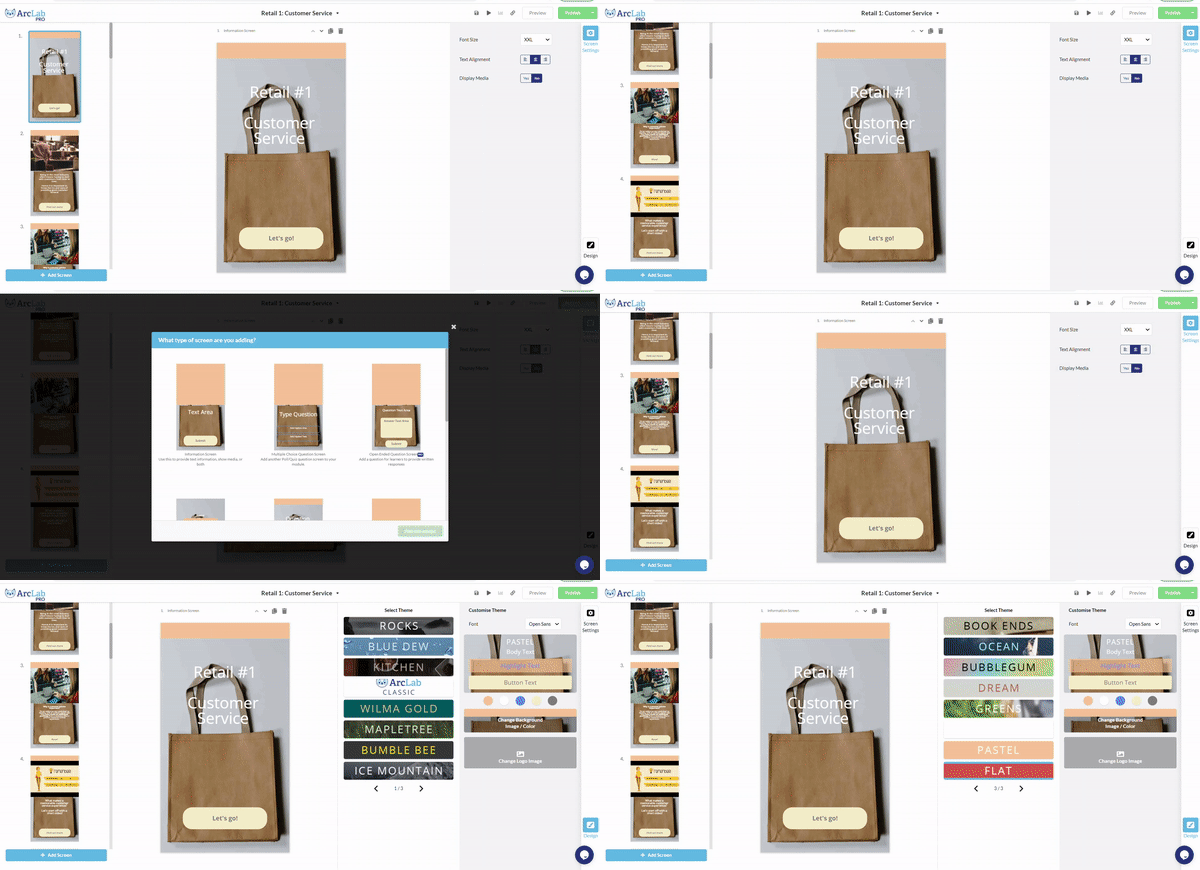
ArcLab Discover has endless templates to help you get started on creating training modules for your learners, saving you precious time and resources. 

It is crucial for companies to stay flexible, while adapting to new training and communication strategies to keep up with changing technologies and employee preferences. ArcLab’s aim is to help industry leaders and managers realise the full potential of their staff and company through proper and effective training in this digital day and age.

P.S. Here’s a bonus retail module to kickstart your company’s digital transformation journey today!

Photos credits: SNEF

Categories
Blog

The Evolution of Onboarding

Technological advancements have not only transformed our daily lives, but has also been a key driving force of economic growth. The current explosion of Artificial Intelligence (AI) and automation has drastically enhanced the productivity and efficiency of various industries and sectors. 

In the Human Resource (HR) sector, many can agree how onboarding has drastically evolved over the years, due to a combination of factors – the most significant being, technology, changes in business trends, environments and workplace cultures or demands. 

Onboarding is without a doubt, a critical stepping stone to successfully integrate a new hire into the company. Without a clear and effective onboarding strategy, the company loses money, time and talent all at one go. Hence, being able to transform from traditional paper-based onboarding to digital platforms has fundamentally altered and benefitted HR processes. 

Going Digital

Digitalising the onboarding experience has streamlined processes for both HR managers and new hires. Automating mundane procedures such as filling up personal details and registering payroll through online systems has taken a considerable administrative load off HR managers. With technology taking over onboarding administrative tasks and logistics, HR managers are now able to dedicate more time to focus on other more value-adding aspects of their job, thereby improving overall job efficiency. Headspace is also freed up to do more strategic HR planning to aid in business strategy, increasing the value of HR to the C-Suite. 

Getting Personal

Onboarding programs have also become increasingly personalised to fit specific job scopes and company departments. Tailoring training modules to meet the needs of different employees and job roles can create an overall more engaging and welcoming onboarding experience for them from Day One. Advancement in technology has also provided HR managers with an easy solution to customise such programs which provides the necessary support new hires require to integrate seamlessly into the company. A successful and satisfying employee onboarding experience can also drastically reduce employee turnover rates and increase talent retention.

Gathering Insights

An essential aspect of onboarding is tracking the progress of new hires, while identifying any areas for improvement. Digitising onboarding processes has allowed HR managers to easily monitor and access new hires’ onboarding progress, through analytics. 

Digital platforms used for onboarding can also serve as a means of communication and training for HR managers and new hires. While onboarding typically only serves as an initial introduction for new hires into the company, HR managers should view onboarding as an ongoing and continuous process (also known as “everboarding“) by intermittently overseeing their employees’ growth. This will in turn provide a holistic development for them. 

Onboarding with ArcLab

Just like how technology has advanced over the years, companies and HR managers too, need to advance with it, by leveraging on the benefits technology can bring about. Digitising training and onboarding material or shifting away from paper-based procedures are not as daunting as it seems! SmartTranslate and SmartTransform are AI-assisted functions available on ArcLab’s platform that aid users in creating modules in mere seconds. This creates an inclusive onboarding experience, and new hires can be onboarded anytime, anywhere, in any language. 

Singapore University of Technology (SUTD) has been leveraging on ArcLab’s platform to successfully deliver onboarding materials to create pre-orientation modules and train their new hires without the need for physical orientation sessions. With ArcLab, they have created an effective onboarding strategy that saves precious time and resources. 

Still hesitant or unsure where to start? ArcLab Discover has a wide range of onboarding templates to choose from to help you get started on your revamped onboarding journey!


Explore more onboarding templates here!
Categories
Blog

Safety Compliance & Training – The Essence of All Construction Businesses

Construction sites are known to be complex and potentially-hazardous environments. Officially, statistics show that in 2023, a total number of 159 accidents took place in Malaysia’s construction industry (this does not take into account potentially unreported incidents). As construction workers are constantly exposed to heavy machinery, work at height and among a multitude of moving objects, the importance of ensuring implementation of proper compliance and safety protocols among them cannot be emphasised enough. 

Malaysia - The OSH Amendment Act

Recognising the importance of workplace health and safety, Malaysia updated its Health and Safety statutory requirements. The Occupational Safety and Health (Amendment) Act 2022 (OSH Amendment Act) will take effect in Malaysia from 1 June 2024. The updated OSH Amendment Act includes the extension of relevance to ALL workplaces in Malaysia (with minimal exceptions), while establishing new safety requirements workplaces must abide by. 


From a business standpoint

Given the varied risks construction workers face daily, construction companies should deem their workers’ health and safety as more than just a regulatory obligation, but a moral imperative as well. One life lost is one loss too many. Additionally, ensuring a safe working environment by reducing the number of preventable accidents boosts overall productivity within the workplace and helps companies cut back on medical and compensation expenses. Companies are also able to reduce turnover rates by retaining skilled workers, while upholding their reputation as a safe construction firm with low accident rates.

ArcLab, shares your sentiments as a construction firm – that proper compliance to safety regulations and guidelines of your workers takes number one priority. Effective training measures are the foundation of any strategy to ensure workers’ safety. It is vital that on-site workers are trained on the proper use of equipment, machinery, and tools, as well as emergency protocols, procedures, and work practices. Refresher courses are equally as important to pinpoint and bridge knowledge gaps, while ensuring workers are constantly up to date with compliance and safety guidelines.

Click to explore different module templates at ArcLab Discover

As a Workforce Mobile Training Platform, ArcLab aims to revoluntionise the way training is delivered from you to your workers. With ArcLab’s fast and easy training solution, training material and assessments can now be accessible by Deskless Workers through their mobile devices – anytime, anywhere, making Mobile Learning much more convenient and on-the-go. ArcLab also provides interactive assessment options and analytics functions to track and analyse workers’ progress and understanding. 


ArcLab has worked to reduce every possible barrier that you, as employers will face when it comes to training your workers. We developed an AI-assisted feature, SmartTranslate, to help create training modules in multiple languages, overcoming any language barriers your workers may previously have faced when being trained. 

It is our moral and ethical obligation as employers to equip our workers with comprehensive training and measures to create a safe construction work environment. With ArcLab, employers can ensure proper compliance, best practices and regulations of workers through Mobile Training.

Categories
Blog

Doing the impossible: Equal training opportunities for all

Doing the impossible: Equal training opportunities for all

With remote work here to stay, at least while the pandemic continues, managers now face another daunting task: engaging and tracking the process of their employees.

A Gallup report on employee engagement shows that companies with a highly engaged workforce have 21% higher profitability. They also have 17% more productivity than companies with a disengaged workforce. So how do companies overcome one of the biggest HR challenges of the present?

Furthermore, with business operations being shifted online, managers are presented with another challenge — the increasing digital skills gap between the younger and older generation of workers. Many older generation workers lack the technological skills to successfully adapt to the changes in technological trends

It is now all the more crucial that managers leverage on their available resources to ensure no employee gets left behind while working remotely in the pandemic— the new employees who lack proper onboarding, or even the experienced, older employees who struggle to adapt to the shift from offline to online. 

Online training and employee polls are just examples of accessible technology available to companies. However, a recent poll by Gartner suggests that only 16% of companies leverage technology to track employee progress and engagement. Perhaps managers are also intimidated by the transition from traditional to online, or are unsure of where to get started?

ArcLab Training

We pride ourselves in giving ArcLab users the best remote training and learning experience possible. This is why we provide support for your workforce anytime, anywhere, in any language (yes, training modules can be created in other languages besides English!). More importantly, ArcLab is easily accessible to low skilled and the older generation of workers. While it is important to upskill your existing workforce, ensuring proper onboarding for new team members is also crucial to ease their transition into your company. ArcLab allows you to create different training modules to conduct your onboarding and training concurrently. Adapt your training materials to cater to the needs of your workforce and training goals. Check out ArcLab Discover to see how different businesses use ArcLab.

See how Fei Siong Group uses ArcLab while training their employees, most of whom are non-English speaking!

ArcLab Technology

With ArcLab, we can help smoothen this process. To streamline the transition process for new users, there is no software to install or download — not only is it user friendly, it does not take up any additional space in your computer database. For companies who are already in the process of transitioning online, ArcLab can even be used alongside any existing HRMS/ LMS. ArcLab’s interface is equipped with a wide variety of tools to help your company deliver training and performance support. Apart from the customisable designs and rich visual media, ArcLab also has a learner assessment and analytics function. Assess your employees’ understanding with the different assessment methods. Track their progress with the data we collate from your learners’ responses. Get to experience the ease of using technology for our low and affordable pricing.

ArcLab’s interface empowers you with a wide variety of tools

The transition from offline to online can be intimidating. Let ArcLab help smoothen that transition and start your journey with us now!

Categories
Blog

Retail’s digital tsunami strikes

COVID-19 forced many industries to pivot to digital, and pivot quickly. The retail industry is no exception.

In the past few years (even pre-Covid), the retail industry had already seen a shift from offline stores to e-commerce | Pic: Unsplash

In the past few years (even pre-COVID), the retail industry had already seen a shift from offline stores to e-commerce as consumers started to buy more goods online. COVID-19 has only accelerated that move into a tsunami.

The lockdowns in 2020 played a huge role in accelerating the transition to digital shopping platforms. E-commerce became the only way that retailers could make their products readily available to consumers and the only means for companies to keep their business afloat.

Retailers now have no choice but to embrace digital.

Data from Singapore’s Department of Statistics show an undeniable increase in online retail sales from March 2020 to July 2020, the period when Singapore entered her COVID-19 Circuit Breaker.

Source: Singapore Department of Statistics

Big e-commerce players like Lazada, Qoo10 and Shopee also saw a spike in platform sales. According to Vulcan Post, Shopee experienced an 82% increase in the number of user visits from 6 million visits in the first quarter of 2020, to 11 million visits in the second quarter of 2020.

Has the e-commerce future arrived “early” for the retail industry?

Indeed, Singapore has witnessed an increase in emerging small businesses online, some online only.

By having an online presence, companies are able to reach significantly more consumers as opposed to relying on human traffic visiting a physical store.

With retailers adding online channels and using technology to their advantage — products, customer service chat, doorstep delivery, personal online shopping and even virtual product try-ons can make your business available to consumers 24/7, all around the world.

Equipping the Retail Workforce for the e-Commerce Present

With operations shifting online, it is necessary that retail training and HR processes be taken digital as well — to increase efficiency and reduce cost for retailers.

Training new hires online isn’t as daunting of a task as it might seem. In fact, it saves companies the trouble, time and money of organising physical training sessions. The training content would also need to change. E.g. Following the shift from physical to online stores, staff need to be retrained to learn how to serve customers online rather than face-to-face.

With ArcLab, creating training modules has been made simple with our easy-to-use interface. Disseminate the modules digitally to all staff at a few clicks of the button and our system automatically tracks their performances and stores all necessary records.

You can use ArcLab ‘s Customer Service 101 series to get you started.

ArcLab Customer Service 101 modules | Source: https://arclab.io/retail

We’ve built ArcLab to be seamless and fuss-free to start. Explore the limitless possibilities with ArcLab platform and get started on your digital transformation journey today.

If you need any help at all, reach out at growth@arclab.io

Categories
Blog

My Intern Experience @ ArcLab

My Intern Experience @ ArcLab

Editor’s Note: Joanna is our first marketing student intern from Singapore Polytechnic School of Business. Her internship period coincided with COVID-19’s escalation, so she had to work-from-home a mere 2 weeks after she started her stint with us. While some may have found it hard to work without closer guidance & supervision, Joanna took #WFH in her stride (read her thoughts here), adapted quickly and was productive for ArcLab very quickly. Here’s Joanna’s story:


Like every other intern on their first day in their new workplace, I was nervous and unsure of what to expect. Interning at ArcLab is nothing like I had imagined interning would be like — but in the best way possible.

Since ArcLab Upskills the World’s Deskless workforce through Nano Learning, I have condensed my entire internship journey into an ArcLab module.

Here is the longer version:

The atmosphere in the office was always welcoming, warm and lively. Both the interns and full-time staff were always willing to help one another out. However, sadly due to COVID-19, we had to start working from home just a few weeks after internship started. Despite not seeing everyone in the office face to face, we had weekly Zoom “stand-ups” to update one another on new projects we were working on and its progress throughout the week.

I was fortunate enough to be given the opportunity to work on several projects, and help ArcLab create & distribute new content to educate prospective users on how digital & mobile learning can help their organisations.

Being new to the Marketing/ EduTech industry, I definitely learnt a lot from the 5 short months that I have been here so far (with the help and guidance of Nicholas, who intern-ed in the preceding 4 months and extended for an additional 4 months to overlap with my stint, as well as James, my supervisor).

The first project I had been tasked with was co-writing a “Guide to Nano Learning” ebook with the Learning Design team. Being someone that loves to write and design, I thoroughly enjoyed this entire project- seeing how it progressed over the weeks, and eventually how it came into completion. You can download it at: https://www.arclab.io

One thing about interning at ArcLab is the endless number of hands-on experiences. James is always open to any suggestions that I have, saying that “as long as the idea is supported with research and reasoning”. This could mean proposing a certain way of doing things, or even coming up with new content for ArcLab. In terms of new content, I was able to help co-create 3 new ArcLab Nano Learning series: 1. “Split Teams & Remote Work” to help organisations ease staff into WFH arrangements with the COVID-19 onset, and multi-lingual training modules for “Domestic Workers” and “Migrant Workers”.

For me, proposing a new ArcLab module series and creating modules was always a fun process. Although it involved a great deal of research, it was always interesting to read up on new topics and take a break from the more routine aspects of work. Under James’ guidance, I also had the chance to design ArcLab’s “COVID-19” solutions page (which listed all the efforts ArcLab undertook to help companies during the COVID-19 situation), a “Solutions” page, as well as a “Product” page on ArcLab’s website. Through this experience, I was able to pick up basic elements of web design and Photoshop and learnt how to create beautiful GIFs.

New ArcLab webpages

Working at ArcLab has also given me vast insight into the marketing science that helps B2B businesses to grow. I helped design and create ArcLab monthly subscriber newsletters, plan our content strategy and manage ArcLab’s social media accounts, write ArcLab blog posts, as well as help improve and revamp ArcLab’s website.

In school, we mainly focus on B2C marketing, which I came to learn was a stark contrast to how B2B marketing is. For example, B2C marketing relies heavily on social media such as Instagram to promote their brand to consumers, as compared to B2B marketing where brands are more heavily reliant on LinkedIn social media.

Another aspect of B2B marketing is Search Engine Optimisation (SEO) and Search Engine Marketing (SEM). Having minimal prior knowledge in these areas as well, working on both SEO and SEM helped me gain deeper understanding in the “technical” aspects of marketing. A key takeaway that I had from experimenting with SEO and SEM is that, it has no one fixed method — it requires several rounds of trial and error to find the optimal method which is best suited for your company and its target audience.

Conclusion

I’m very grateful for the chance to intern at ArcLab, as it has been an experience filled with countless number of opportunities, and gaining new exposure to several aspects of B2B marketing that I did not have the chance to learn in school. While the current COVID-19 situation has not been the most to intern in (having to work from home), it taught me a lot about discipline, and the importance of regular communication.

With more and more organisations coming to recognise the convenience and benefits brought about by Nano Learning (Mobile Learning) due to the recent COVID-19, it is no doubt that Nano Learning is here to stay even after this pandemic.

Categories
Blog

ArcLab Dev Update — What’s New?

ArcLab Dev Update— What's New?

Editor’s Note: Last month, Joanna interviewed Claire, our former dev intern so instrumental in assisting CTO Steven in building ArcLab. This month, Joanna speaks to Rohit Rajesh and Kimberly Pontanares to get their perspectives on working with Steven to develop ArcLab.

Rohit interned with us after completing National Service and while awaiting University admission. While not formally-schooled in software development, Rohit brought substantial coding knowledge from self-study and Tinkercademy classes, a relentless drive to build great software and a great learning attitude.

Kimberly continues ArcLab’s tradition of collaboration with Singapore Polytechnic’s School of Computing, following in the footsteps of Claire, Francis, Darryl, Zainul and Bing. Adept in coding and possessing a great visual sense, she’s a showcase of the excellent work SP does in nurturing industry-ready tech talent that will play (and are already playing) a big part in solving real-world problems to improve lives and livelihoods.


Rohit (L) and Kimberly (R), ArcLab super-interns


We are excited to once again bring you a new ArcLab Platform Update for August!

This month, I interviewed Kimberly and Rohit who were involved in the upgrade of the new ArcLab dashboard.

Joanna (J): “Hi Kimberly and Rohit! Thank you for agreeing to this interview. We wanted to get some insights from the creative minds behind the new ArcLab upgrade!”

Kimberly (K): “Thank you! First, let me explain what we have designed:”

Learner Analytics— Filter Feature

Filter your learner analytics and view the analytics of your published project by date. Simply select the start and end date on the calendar tab to segment your learners (by cohort, etc.)!


Filter your analytics by date

Media for EVERY ArcLab screen

Media can be added to almost every screen … or not — the choice is yours!


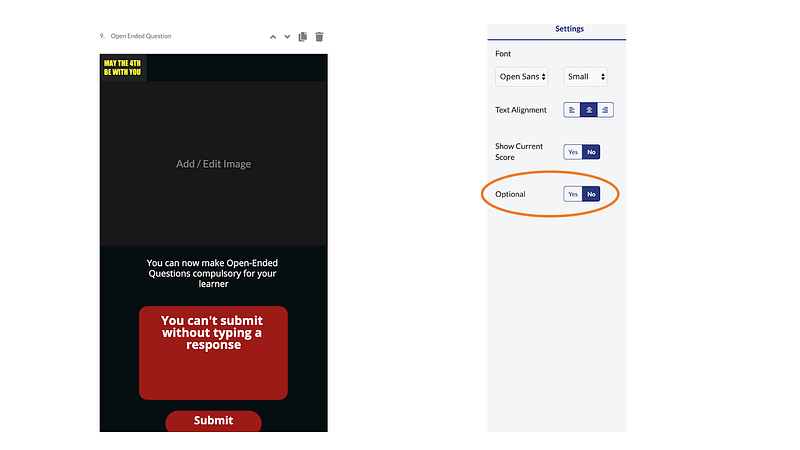
Adding images to each screen is now optional

"Project Settings"—Reloaded

We have also split “Project Settings” into 3 tabs — Manage Learners, Manage Emails, and Question Settings, so that Training / L&D Managers have greater granularity of control!


“Project Settings” is split into 3 tabs

Folders

Lastly, we added a folder system in the ArcLab Dashboard. This feature allows you to move projects to folders, so you can manage your various projects more easily and effectively. You also have the ability to rename, delete a folder and remove a project from a folder.


Folders added to dashboard

J: “Wow! I hope ArcLab users will find these updates as useful as we did! Could you guys share the reasons behind including these features?”

K: “For sure! The folder system was something Claire and I discussed being included for ArcLab’s UI/UX Refresh. We included it to provide users a way to manage their projects more efficiently by enabling them to further categorise their various projects and facilitate easier access.

While the filter analytics by date was included to further enhance users’ experience when studying learners’ analytics by allowing them to view the calculated statistics (which learners completed the module, how many attempts did a learner take on a specific date, etc.) This also makes it easier to find specific learners that completed the module within a certain date, and help L&D managers segment users into cohorts for easier tracking.”

Rohit (R): “Meanwhile, media inserts were added (and made optional) on a variety of screens so that learners can be exposed to media regardless of the ArcLab screen type. All in all, this allows for more flexibility in the creation of projects for learners — to make learning more effective.”

J: “Thank you for sharing! Lastly, could you give us a sneak peek of what we can expect in the next update?”

R: “Of course! Do stay tuned for the next update because ArcLab’s dev team is excited to bring you:

What to expect in the next Dev Update?

ArcLab’s team is always listening to your feedback and seeking ways to improve — part of our never-ending quest to build the world’s Simplest Learning System.

You can next expect:

  • A “Discover” feature where L&D Managers can source training templates to adapt to their organisations’ specific needs.
  • Further enhancement of the Learner Analytics Dashboard
  • Additional features such as editing and uploading photos in the Question Bank.

… and several more! Follow ArcLab on LinkedIn, Facebook and Twitter to find out!”

J: “Thank you for your hard work, Kim and Rohit! With both your internships ending soon, what did you learn most from your time at ArcLab?”

R: “Firstly, I learnt how to work effectively from home as I sadly only managed to spend a day in the office before being restricted to WFH (due to Singapore’s COVID Safe Management Measures). I realised that creation of daily task lists and a rough timetable for the day help immensely!

Under the guidance of our CTO Steven, I was exposed to DevOps as well as technologies like Docker and Jenkins in order to streamline development processes in the firm. Some notable ones include the creation of Continuous Integration / Continuous Delivery pipelines allowing for rapid deployments and testings and containerisation of the application for developmental work. I was also further exposed to tools in Amazon Web Services (AWS) such as Lambda, S3, CloudFront, and Elemental MediaConvert in the creation of the video upload feature for learners.

I also learned how to work closely as part of a team. As a lean team, communication and teamwork are paramount to the monthly updates we push out for our users. This includes biweekly sprints, where we gather feedback from users and prioritise tasks. We have weekly “standups” where we talk about what we have achieved in the previous and the coming week, and, of course, daily chats with colleagues on bugs that were discovered and/or any user requests that require urgent attention. With WFH, the importance of communication was amplified, as you could no longer just shout over your shoulder to find out what your fellow dev was up to or to look for help.”

K: “While working at ArcLab, I learned a great deal about the process to find the most efficient way to develop and implement features that give our users the best user experience. I am truly grateful to have had the opportunity to work and learn from everyone here.”

J: “Thank you to both of you for sharing your insights!”

Now check out the Brand New ArcLab User Guide: https://arclab.io/knowledge-base !


Postscript — Rohit will soon start his undergrad studies at National University of Singapore, while Kimberly heads back to Singapore Polytechnic for her final semester. We wish them both the very best and hope they put ArcLab at the top of their list when considering future employment. 😊

Categories
Blog

Developing a Brand New ArcLab Dashboard

Editor’s Note: ArcLab believes in authentic learning. Students interning with us work on REAL projects to help them translate school-learnt theory into industry-relevant skills.

Singapore Polytechnic School of Computing student Claire Liew interned with ArcLab in 2019–20, working closely with our CTO Steven to build features of ArcLab’s mobile learning software platform. Claire was mature, self-driven, resourceful and had great design & coding chops. Guided by Steven, Claire led ArcLab’s dashboard upgrade — continuing ArcLab’s never-ending quest to build the World’s Simplest Learning System, to help organisations everywhere Upskill the World’s Deskless Workforce.

We interviewed Claire in in her last internship week to get her thoughts on building ArcLab’s new dashboard.


Claire Liew, ex-ArcLab super-intern | super-Software-Engineer


We are excited to introduce your Brand New ArcLab Dashboard! 🤗

I interviewed Claire about the upgrades we launched earlier this month.

Joanna (J): “Hi Claire! Thank you for working so hard on the new ArcLab Dashboard. We’ve been getting great feedback from users and wanted to tap your views on what went behind the new design”.

Claire (Cl): “Thank you! First let me explain what we built:

Sorting & Filtering your learning modules made easy

  • A search bar to search for a specific project name
  • View your projects in 2 categories: “Unfinished” or “Published projects”
  • Use the column headings on the table to sort your projects in ascending/ descending order based on Project Name or Recency
  • Delete or duplicate your projects just with the click of a button

These features save you the trouble of scrolling through your entire dashboard just to find that one module you are looking for!

More intuitive Navigation Bar

Features such as Project Settings and Learner Analytics have been moved to a more optimal and intuitive location in the Editor. Take a look at the graphic below, and also see ArcLab’s user guide for comprehensive step-by-step instructions!


Step-by-step guide to adding authorised learners

Compulsory Open-Ended Questions Toggle

We also now give users the option to make Open-Ended Questions compulsory. This is particularly important for Assessment modules (which we’re also considering ways to make the grading process more automated and intuitive — stay tuned for that).


Open-ended questions can now be made compulsory

Send Digital Certificates to Learners

We received feedback from many users asking if they could send a “completion” certificate to learners.

The answer is now YES. If you are an employer or content creator designing these modules for your learners, you can now personalise your employees’ learning by sending them digital NanoCreds (certificates) when they complete/ pass the module. The best part? Being able to include your OWN digital signature on the certificate as well!


Step-by-step guide to mail digital NanoCreds to learners, personalised with your e-signature

J: “Wow, Claire. I hope ArcLab users will enjoy this update as much as I do! So why did ArcLab include these features?”

Cl: “We included these features because we keep learning from our users to keep improving the platform so it can better serve user needs.

We had received feedback that the ArcLab dashboard should let users more easily visualise all the learning modules and analytics at one go. So we took it on board and iterated our design to help users do just that.

By improving your module editor in the other small ways I described above, we hope creating #nanolearning modules can be made even more fuss-free and personalised (for you and your learners)! As we get more user feedback, ArcLab will keep improving the platform.”

J: “Thanks for sharing Claire! Just one more thing — could you possibly give us a sneak peak of what we can expect in the next update?”

Cl: “Of course, do stay tuned because here’s what ArcLab’s dev team is building:

What are we building next?

Our team keeps working hard to listen to users and build what’s needed to best solve user organisations’ training pain points. We will soon release:

  • Video Uploads (for ArcLab PRO users) — this adds to Youtube/Vimeo videos you can already embed directly into ArcLab modules
  • Explanations for MCQ Answers — allowing your learners to see individualised explanations based on their answers

…and several more which you should follow our blog to find out 😉 ”

J: “Thank you for your hard work, Claire! What did you learn most from your time with ArcLab?”

Cl: “I learned how rewarding it is to be able to ship live features tailored to our users’ needs. Also, I’ve learned a lot of technical and soft skills from everyone here at ArcLab. It was definitely an enriching experience for me.”

J: “It’s been really great to be team-mates. All the best to your future endeavours!”


Postscript— Claire graduated from Singapore Polytechnic and will soon start her undergraduate studies at Singapore Management University. We wish her the very best and hope she considers us favourably when contemplating future employment opportunities 😊

Meanwhile, if you have any feedback or suggestions, please drop us an email, we would love to hear from you. ArcLab continues to work hard to #Upskill the World’s Deskless Workforce. Always #Day1.

Categories
Blog

#WFH as an ArcLab Intern

WFH as an ArcLab Intern

Editor’s note: ArcLab is privileged to work closely with Singapore Polytechnic (“SP”). In March 2020, we welcomed Joanna from SP’s School of Business to intern with ArcLab till Aug 2020. Alas, Singapore moved into #CircuitBreaker mode which meant Joanna had to #WorkfromHome after just 1 1/2 weeks.

Here’s Joanna’s story, and what she built to help organisations get staff ready for Remote Work Arrangements.


By now, majority would be familiar with the telecommuting lifestyle following the Circuit Breaker measures implemented by the Singapore government just last month. I was privileged enough to be able to intern from home as well. Being my first time working from home, it definitely took time adjusting to a different lifestyle and I thought I would share my experience so far…


Photo by Nolan Issac on Unsplash

Since we are on the topic of lifestyle changes, a significant change for me was not having to wake up as early as before Circuit Breaker to get ready for work. I think this is something many people can resonate with. Whether you are a working adult or an intern, showing up for work on time means having to wake up 1, 2 or even 3 hours earlier! You could be taking a longer time than necessary choosing an outfit for work, making breakfast, or even having to drop your kids off at school before rushing to work.

However, with the new Circuit Breaker measures in place, time taken to get ready for work online is significantly reduced. You no longer have to worry about getting your children to school on time. You can even be working in your PJs and enjoying that cup of coffee while answering to work emails. Working from home now means being able to get an extra hour of sleep! Of course, with every benefit there is a downside.

Working from home also taught me a lot about how productivity and discipline go hand in hand. With no one (manager, supervisor, or even colleagues) constantly keeping you in check, it can be hard saying no to distractions. It could be constantly wanting to crawl back into bed, or making rounds to your fridge looking for a quick bite. What I found helpful for me was writing down a to-do list for the week (and although this may not be the first time hearing such an advice, it really does help!) — and once I was done with a task, I would have the satisfaction of crossing it off the list.


Photo by Allie on Unsplash

With an increasing reliance on technology, I realised how we often take it for granted, because without it we would hardly be able to get any work done, let alone communicate with our friends and colleagues (even more so during this period). At ArcLab, we use Slack and Zoom to communicate with each other. We even have scheduled weekly Zoom call meetings to update each other on the progress of our work and how our weekend has been.

Speaking of technology…

Split Teams & Remote Work modules

A main project that I have been working on was creating modules for Nano Learning modules for ArcLab’s new “Split Teams & Remote Work” (or WFH) series. The series was created in line with the WFH measures implemented by companies, to help both employers and employees alike adapt to the new work arrangements. If you have yet to check it out or have a few minutes to spare in between your day, you can do so here!

ArcLab’s Work From Home series

With the hustle and bustle of work, it’s very rare that we find time to learn something new, or pick up a new hobby. We probably steer clear of this as well due to our perception that learning = lengthy = time consuming.

ArcLab Nano Learning modules (such as the WFH series) has thus been made targeted, specific and short so that you can slot learning into your busy schedule, without taking up too much of your time!

My WFH experience has been a fulfilling one so far, and I certainly hope yours has been too! Press on, the Circuit Breaker is almost coming to an end, and we would soon be a step closer to resuming our lives as normal.

#StayHomeStaySafe #NanoLearning