Before we can go into Nano Learning to understand how it is being increasingly used by companies, we must first look at the situation that is resulting to increase in wages of blue-collar workers and subsequently, higher costs. This is to help us see how Nano Learning comes in to help businesses save cost in training and provide a more effective training programme for their workers. Hence, leading to an increase in workforce productivity.
Is everyone quitting their jobs?
Is the #GreatResignation only taking place among higher-salaried knowledge workers?
A reasonable line of thought is these are the workers who’ve managed to build savings buffers during COVID-enforced travel bans and rising asset markets, giving them enough runway to resign from jobs that they may be tired of & reassess their lives.
Apparently, that’s not quite true.
Blue-collar workers are leaving their jobs too. In countries like the US and Singapore, job openings in food services and other deskless workforce-heavy industries are rising – as workers quit and there’s no ready pool of unemployed workers to take these traditionally low-end jobs. Singapore’s F&B businesses face the double-whammy of being reliant on non-local workers, and their increasing unavailability due to tightening work visa requirements etc., has hurt businesses’ daily operations, not to mention any possible expansion plans.
As a result, the manpower crunch is driving up wages in “blue-collar” vocations.
Rising wages (both market-driven and legislation-driven) is good for workers. However, compounded with supply-chain bottle-necks, rising real-estate prices (read: rentals) all exacerbate the increase in costs for employers – which would have to be passed on in some part to the end-consumer.
Ultimately, these all contribute to the rising inflation in many countries today, which hurts all of us as our paycheques (and business topline) don’t stretch as far as before. Left-unchecked, this becomes a vicious cycle of rising wage -> costs -> wages -> costs… which our Central Banks and Governments are now working hard to address at the macro-level.
Achieving more with a smaller but more productive workforce
On a micro-level, increased worker attrition means your business needs to hire replacement workers for critical roles, and onboard & train them with increased frequency.
This also means you need to train your staff to perform their roles well, and possibly cross-training them to do one another’s job during busy shifts, especially if higher market wages means your business may not be able to afford to hire as many workers as before.
Traditionally, this training was done in person but may no longer be possible in today’s COVID environment. A digital approach is often necessary. In fact, digital learning in bite-sizes (or what we term as Nano learning) is a simple, effective, scalable way to onboard and train new and replacement workers.
What is Nano Learning?
Nano Learning refers to breaking down learning materials into small units of information whilst increasing engagement, crafted to aid in learners’ understanding and information retention.
To break down our Nano Learning definition:
1. “Bite-sized” training modules lasting between 2 and 10 minutes
2. “Highly targeted” with each module focussed on ONE single learning objective
3. “Interactive” with rich media and on-the-spot digital assessments used to promote learner engagement and enhance learning retention.
The Nano Learning delivery method of training is a great andragogical framework which Engages Learners, Helps Learners Apply Knowledge and is Available On-Demand. It can be used for education, training, onboarding etc.
In a workplace setting, long periods of “training” or long text-based reading is hard to accomplish. This is especially true for our workers in operational (or Deskless) roles, who do not have workstations or computers. Hence, training and upskilling is best done via their mobile phones.
How to use Nano Learning in Staff Training?
That’s where a Nano Learning Tools like ArcLab helps your business – by giving you a one-stop tool to easily create, distribute and track training for your workforce – anytime, anywhere, in any language.
ArcLab’s Nano Learning platform data shows that our customers save an average of 11 hours of time per worker per month. Time that can be better-deployed to business operations, and focus on the ‘human’ aspects of the business, like delivering great customer service.
Workers interact with the digital training content, are tested on their knowledge via quizzes, and can apply it easily to their work. That’s learning in the flow of work in action. Staff training at its most efficient.
The end-result? A well-trained workforce that does more for your business.
In today’s #GreatResignation, it is crucial to have a scalable and effective way to onboard and upskill your new and replacement workers, and invest in your existing staff to achieve more for your business.
It becomes a strategy to implement and integrate nano learning courses and modules into your training programme. Here’s an example of how it can look:
Time to start Nano Learning for your workforce training!
Read More On Increasing Productivity with Nano Learning:
Did you know that up to 93% of communication is non-verbal?
This means we can communicate without even saying a single word. For staff in a customer-facing role, positive non-verbal communication can be a powerful amplifier to be more welcomed by customers.
What is Body Language?
Body Language refers to “gestures, movements, and mannerisms” by which a person communicates with others (definition from Merriam-Webster). These are your non-verbal cubes that communicate how you feel, and are typically performed subconsciously.
Fans of US crime dramas might remember the series “Lie To Me“, where Tim Roth’s character assists law enforcement agencies in investigations with his expertise in studying “micro-expressions” and body language.
What’s said can sometimes be different from what is unsaid. Our body communicates sub-consciously.
Body Language and Good Customer Service
Few of our businesses are in law enforcement or psychology. Why should we care about body language?
While a fundamental factor of a successful business is a product that solves customer problems, how a salesperson or a customer-facing staff communicates can be the key between a sale or a customer walking over.
Positive body language helps your workforce communicate better with customers, and affects how customers react. Hence, we need our salespeople to pay exceptional attention to body language.
This is true irrespective of whether you business is brick-and-mortar, or (increasingly today) an online business. That’s because body language CAN carry across the phone, or even an online chat. When your service rep is frustrated, he/she may end up with a very different chat message compared to when when he/she is a good frame of mind. The sub-conscious body language can translate into different choices of words – which CAN be misconstrued by customers over that chat.
Bottom line: All your customer-facing staff need to convey positive body language in their interaction with customers (and prospective customers as well)!
What are examples of positive body language that your staff should exhibit? Here are three:
1. Eye Contact
Make eye contact before speaking with a customer. This is to let the customer know that he/she is actively engaged and actively listening. Be careful not to overdo it though. Staring too intently can make the customer feel intimidated.
A good rule of thumb is to maintain eye contact 50% of the time while speaking and 70% of the time when listening.
2. Keep an Open Stance
An open stance signals friendliness and open-ness. That’s in contrast to body language like crossed arms, which is a closed, defensive posture.
Standing in an open manner makes the customer feel welcome, and also makes it easier to make & maintain eye contact (point 1 above)
3. Smile 😊
Smiling creates a positive effect on people. It makes one appear more approachable and positive. A prospective customer feels welcome and would be more willing to speak to your smiling salesperson rather than one who is sullen and disinterested.
What other examples of positive body language can you think of?
How to Train Body Language for Good Customer Service
Positive Body Language can be taught to your staff.
First – make staff aware of the different examples of body language – both positive ones that they should adopt, and negative ones that they should avoid.
Show pictures, or better yet – a video of each body language example so that staff know exactly what to do and what not to do.
Second – Make staff put what they have just seen into practice via role-play. The old adage “Practice Makes Perfect” is always true, especially for skills-based training.
Third – Provide an SOP of dos & don’ts of body language so staff can easily make reference to it, and after review, practice with colleagues or on their own – anytime, anywhere. Examples of Body Language and other SOPs can be found in ArcLab Discover.
Good body language is an important part of communication. Nowhere is this more crucial than when interacting with customers.
A well-trained sales force and customer service team can help your business better interact with customers and help your business grow, whether you are a retail business, or running a food chain selling delicious local delights. Any business for that matter.
To use and adapt ArcLab’s free Body Language Customer Service training modules for your staff, simply click here:
Ever encountered a problem and went to search for a 1-minute “How-to” video to solve it?
(drumroll…) You’d just done a session of Nano Learning. Well done!
We’ve been subconsciously incorporating Nano Learning in our day-to-day lives, and it has become increasingly popular in corporate training.
Nano Learning is Bite-sized Learning: a quick and efficient way for organisations to train their workforce and equip them with basic knowledge to perform their roles - with training conducted in the flow of work.
What separates Nano Learning from other types of training?
As its name suggests, “Nano” means small.
Nano Learning Definition = bite-sized pieces of training or learning.
Nano Learning can be as short as a minute for small learning ‘nuggets’ or up to 10-15 minutes for the learner to absorb longer pieces of information.
Simply put, Nano Learning refers to highly-focused training through bite-sized chunks of learning content, often in an engaging manner, with a single learning objective.
Why Nano Learning works - the science behind bite-sized learning
When large chunks of information are condensed into digestible content modules, learners can focus on key learning points instead of being bombarded with information that may not be directly relevant to their learning goal.
Furthermore, Nano Learning that is delivered digitally to your learners’ mobile devices also means the bite-sized training content can be easily accessible by your workforce, who can train in the flow of work, or learn at their own pace and in their own time.
Short durations of effective bite-sized learning can be also easily slotted into small pockets of free time amidst their hectic schedules, e.g. while on a commute.
This reduces the need for businesses to take staff away from the shop or restaurant floor to attend day-long (or longer…) training sessions.
This improves workforce productivity to help meet your organisation’s goals, and helps your team to grow their output and improve your business’ bottom-line.
The focussed nature of NanoLearning makes it easy for specific groups of your workforce to be targetted with learning goals and bite-sized training content catered specifically for them.
(i) Just-in-time Learning: Your staff can apply what they learn immediately to a task or problem at hand.
(ii) Closes Skills Gaps: You can identify and close any margin skills gaps your staff may have.
(iii) Fits Modern Workforce: With shortening attention spans, bite-sized training modules makes it easier for your staff to slot learning into their schedules.
2. Reduces learning & development cost and effort
Nano learning saves your organisation time and money.
It is far cheaper to roll out Nano Learning to your staff. No more logistically-intensive classroom bookings or external trainer fees. Modern Nano learning SaaS like ArcLab also means no more expensive courseware development fees from vendors who might charge an arm and a leg to build training modules for your workforce.
With training content made available on the cloud, staff can access the bite-sized learning modules repeatedly, without repeat cost.
It also takes significantly less time to author and refresh training modules when content needs to change. E.g when a new workflow procedure is instituted. This ensures your training content is always current, and there’s no time wasted by your staff in learning old content that is no longer relevant.
Viewed holistically, by saving time and training cost, organisations like you can effectively gain funded headcount, which you can then use to increase your firm’s output and topline.
You now have a clear idea of how Nano Learning (or bite-sized training) helps to complement your organisation's L&D framework.
Employers are always on the lookout for prospective hires with skills for the job at hand, and have potential to grow into larger roles.
Unfortunately information is asymmetric, and it’s not easy to know ex ante who in our applicant pool are adequately-skilled, and who are insufficiently so. Some hires will fit well and do the job. Others won’t. That’s the risk we take.
Here’s something I’m starting to think about… isn’t hiring similar to investing?
It is hard to consistently generate alpha in markets. In fact, investment disclaimers tell us that ‘past history is not indicative of future performance’. Yet we do the very opposite for hiring!
Pedigree is not a precursor of performance.
I am starting to wonder if for hiring, instead of attempting to pick ‘alphas’, we can consider building a team of ‘betas’ that are coachable.
Hirers never truly know. There are no sure-wins. In professional football, not even ‘proven winners’ like Jose Mourinho could do the job at Tottenham Hotspur, while then-unproven upstarts like Mauricio Pochettino outperformed and brought 4 years of Champions League to North London.
Is Skills-based Hiring a myth?
LinkedIn recently announced “Skills Path“, a pilot skills-based hiring programme, supported by Singapore’s National Jobs Council.
The topic of skills-based hiring is not new and comes up every few years. In fact, I co-wrote an opinion piece on Skills-Based Hiring 3 years ago.
LinkedIn’s announcement checks all the boxes. Unfortunately it doesn’t move the needle. There is a grand total of 8 companies under the programme offering a mere 6 job roles: customer service, data analyst, project manager, recruiter, supply chain coordinator and sales development.
To be fair, this initiative is a pilot. I fully support starting small, tracking the data, and if it looks like it works, scaling up only then.
As what I co-wrote above (and the LinkedIn initiative postures), the hope is for hirers to look past academic qualifications as a non-negotiable filtering tool for prospective candidates.
Otherwise, no matter what is said and done, incentives will drive behaviour, and every rational student will pursue the degree, because non-graduates continue to be disadvantaged at the hiring gate, and for career advancement.
Incentives drive behaviour.
Should we NOT try to pick winners?
Hiring well is crucial for every organisation. It’s also exceedingly-hard to do well, for reasons discussed above.
Which is why there’s so much money being spent on good hiring solutions, and much innovation in this space. The Singapore HRTech Market Map (brought to you by hrtech.sg & Adrian Tan) lists the different companies providing solutions for your organisation’s Talent Acquisition needs.
I wonder if we could take a different approach, and look further down the employee journey. I’m referring to the Talent Development area, where ArcLab has some track record (irony intended).
Since it’s so hard to bet on winners when hiring, could we adopt a more “portfolio” approach, especially if we are a large organisation. This means not optimising for the perfect ‘alpha’ candidate, since he/she does not exist. Rather, we do a few things to attract the ‘beta’ candidates:
Properly profile job requirements & packages. No ‘padding’, no ‘undercutting’
Set a minimum bar for the candidate. Everyone who meets this gets an interview (virtual or otherwise), which is more to assess team fit. Involve the team in the interview and give everyone an equal vote.
Suss out open-mindedness and ‘train-ability’. Look for evidences of picking up new skills and applying them.
Where possible, consider a work trial for demonstration of competency, softer skills and fit with potential colleagues.
Hiring a team of ‘betas’ means we don’t go all out to find Ivy League graduates. It means we put in place an exceptional learning & development programme, because we know that investing in our workforce gives our organisation the best chance of success.
Since people are the lifeblood of our organisations, we should put our money where our most important assets are, and invest in them, through training them to be the best professional that they can be.
The best part of this approach is, by hiring coachable people who have not yet been ‘proven winners’, we hire humble people, who are not afraid to admit they don’t know. They are then able to learn what’s needed to do their job so the organisation (and they) succeed. And when business requirements change, they change accordingly.
That means continuous, bite-sized training. Because no longer do we study for the first 10-20 years of our life and work for the rest. We study for a basic minimum, and keep learning as we work.
I submit to you that this is one good way for an organisation to succeed.
We’re building that sort of organisation at ArcLab, and helping many companies build theirs.
A few years ago, our girls’ kindergarten informed parents they would have to increase school fees, which had been kept the same for the previous 10 years.
We greatly appreciate the love, care and education our girls received from their kindergarten teachers, and believe the fee increase was justified. Otherwise, how could the kindergarten continue to pay competitive wages to hire and retain good teachers, of whom our girls were direct beneficiaries? Furthermore, having no fee increase for the previous 10 years in effect meant the school fees we paid had fallen year by year, when we take inflation into account.
We acknowledged the letter and agreed to the higher fees.
One parent was unhappy with the fee increase. The irony was this was a well-off family (I gathered this from watching the family roll up to the kindergarten in a Volvo most days). The parent started to canvas other parents to protest the kindergarten’s fee increase.
When the parent-in-question came round to us, we politely informed her:
“It was unfair to expect OUR OWN WAGES to continually rise, but expect our kindergarten teachers’ wages (aka our costs) to remain unfairly low.
That was hypocritical, not to mention foolish; not paying market-level fees would only result in the school not being able to hire good teachers, and our children would be the ones losing out.”
I do not think we got through to that parent, who I don’t recall ever spoke to me again.
But I am thankful the fee increase went through, because it is fair to pay more for better goods and services, which our girls benefitted from. I am also grateful that we could afford that justifiable fee increase.
Higher Productivity for Higher Wages
Singapore Prime Minister Lee Hsien Loong’s 2021 National Day Rally announced a stronger thrust of support for lower-wage workers. These include:
Extending the Progressive Wage Model (essentially sector-specific minimum wages that rise annually) to more sectors and more occupations
Requiring companies employing foreign workers to pay at least the Local Qualifying Salaries to ALL local staff
Accrediting companies that pay all their workers Progressive Wages with a new “Progressive Wage” Mark (a new requirement to sell to the public sector)
Lowering the qualifying age for Workfare Income Supplement from 35 to 30 (to help younger lower-wage workers)
These are significant steps, because (point 4 aside), the Singapore Government is now also looking at EMPLOYERS and CONSUMERS to foot the bill for the mandated-increased wages.
Paying higher wages to workers directly affects payroll costs for businesses. The higher costs might also be passed to customers in the form of higher prices, depending on the price elasticity of demand. That extra dollar must obviously come from somewhere.
Higher costs are not easy to bear, especially when many companies and many workers have been negatively-impacted by COVID. As a business ourselves, we understand it fully and feel it directly.
Higher wages for low productivity is unsustainable. The market will make sure of that. Neither is a race to the bottom for wages the way forward for Singapore.
Instead, what we must have is higher wages for higher productivity. This is the very mission statement of ArcLab:
Higher productivity only comes about with technological progress, more and better capital, and a better-trained workforce.
Higher productivity is a positive sum game for the business and for the worker, because output increases and/or quality improves. This means justifiably higher prices for goods and services, which funds the higher wages. Higher wages also means better spending power, which flows back to businesses.
This data from the Economic Survey of Singapore speaks for itself:
Higher productivity simply makes good business sense.
Using ArcLab saves you training cost, cuts down training time, and helps your business do more with less. This means higher productivity and better bottom line.
The savings enables your business to pay better salaries to your workforce, who are then better taken care of, more highly-motivated, and have higher spending power too.
Singapore is taking our first step towards this virtuous cycle.
Higher Wages for a Better Economy. And a Better Society.
ArcLab is encouraged that societies are taking more concrete steps at addressing income (or rather opportunity)-inequality issues. That may be one of the silver linings of COVID-19, where we have newfound recognition for our frontline workers, many of whom are lower-income workers.
Yet more than inclusiveness, higher wages for higher productivity is simply good business, and a positive sum game for all.
ArcLab believes that’s the best way for our companies, our workers, and our society to succeed.
We’re building that sort of organisation at ArcLab, and helping many companies build theirs. Companies like Fei Siong Group, 4FINGERS and many more.
Since we launched ArcLab, we’ve had the privilege to empower organisations to easily create, distribute and track training.
Adopting a #Day1 mentality, we’ve listened to our customers and users as we grew (our thanks to each and every one of you) and shape our development roadmap. Responding to all your feedback, we keep working on ArcLab, improving platform stability and introducing features to help managers reduce time in creating & delivering modules to your workforce.
Discover ArcLab Discover
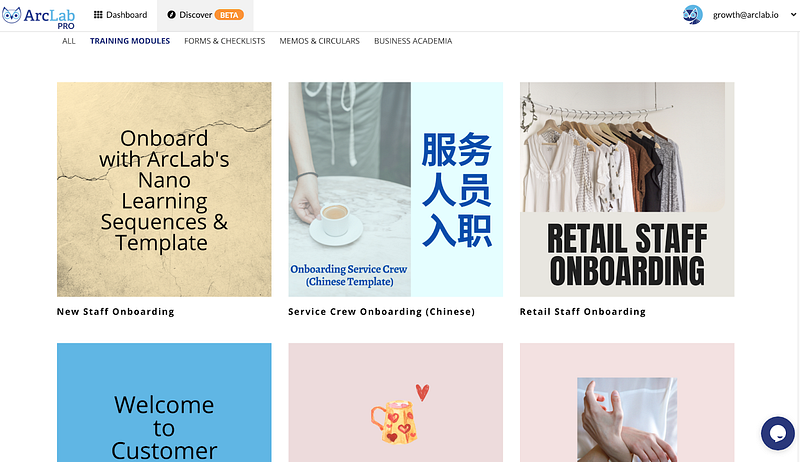
I’m excited to introduce ArcLab Discover, a collection of 40+ (and growing!) templates that span Learning & Development, Human Resources and Operations, in English & other languages that best suit your workforce.
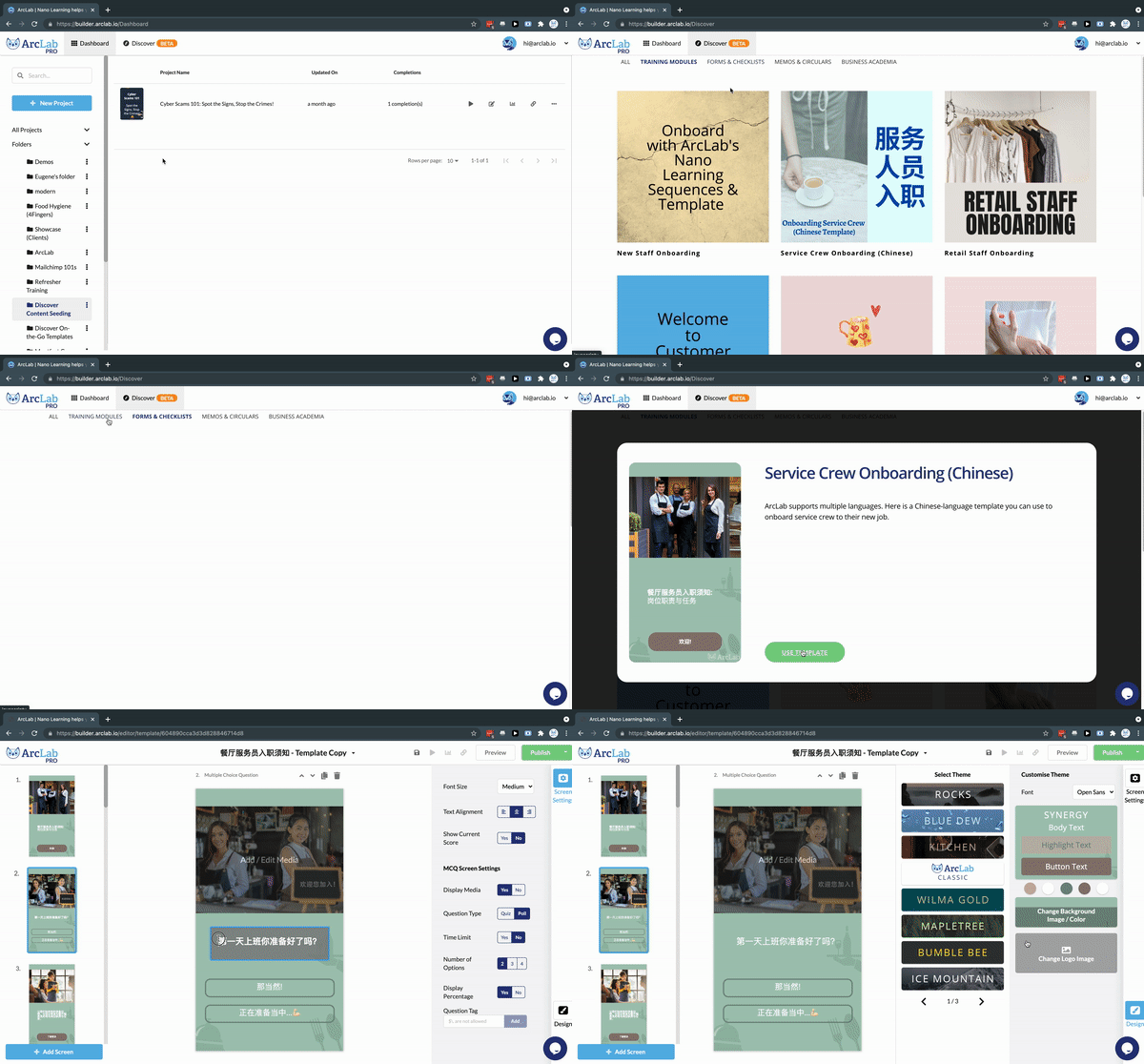
Review templates for Onboarding & Staff Induction, Training, Digital SOPs and HR use cases like EES etc. that suit your organisation’s needs. Remix them into your ArcLab Dashboard with the click of a button, saving you >50% of module creation time. Adapt the content to the specifics that fit your organisation or workforce.
We don’t take the credit for everything in ArcLab Discover.
Rather, we are grateful to tap on the wisdom of the ArcLab community, some of whom have made their modules public and given permission for us to “template-ise” modules for all ArcLab users to remix and use for your workforce.
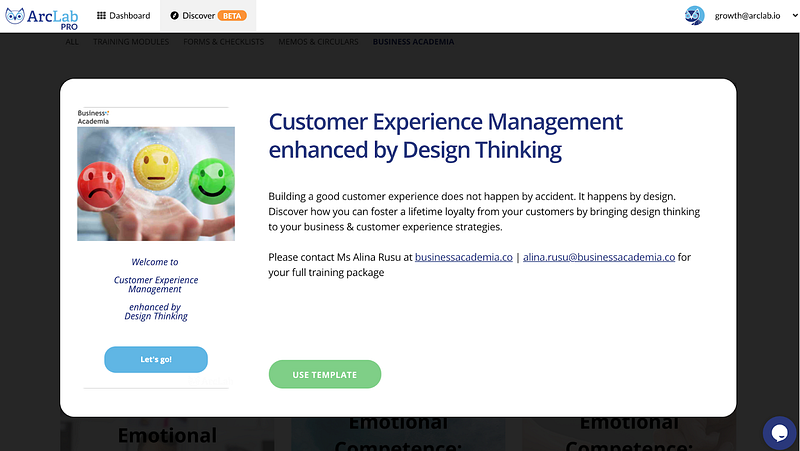
I’m also glad to introduce a series of 6 complimentary Learning Modules by our friends at Business Academia, a consultancy who helps organisations and teams to diagnose, design, test and implements customer centric learning solutions and digital strategies led by design thinking and agility.
Discover Business Academia’s learning modules on ArcLab Discover
Keep Discovering!
p/s ArcLab Discover is still in beta as we refine it to include upcoming improvements like industry/role-specific modules, favourites, ranking and others.
So let us know how you think ArcLab Discover can be improved for you, and what other templates or modules you wish to see in it, that can best support your workforce. Our goal as always is to keep solving your organisations’ problems, and remain useful to you.
We’re also happy to include any modules or templates that you might want to share with the ArcLab community. Simply send them to us via growth@arclab.io.
Digitalisation is NOT expensive and is well within the reach of Small & Medium Businesses. This is how to start it for your organisation.
Lest some may think we can quickly revert to our pre-COVID lives, the virus’ mutations and continued spread suggest it will be with us for some time.
Globally, the South Asian COVID situation continues to cause concern. In Southeast Asia, a significant increase in COVID cases led Malaysia to impose a 3rd Movement Control Order while Singapore regressed to Phase 2 (Heightened Alert).
As we gear up for tightened measures once again, one silver lining is that there has never been more support than ever for the adoption of digital, both at the individual level, and for businesses.
If your organisation hasn’t started digitalising your operations in one form or another to operate in the COVID-normal, there isn’t a better time to start. There are many different software in the market that are affordable and easy to adopt.
How to Go Digital today?
It’s important not to start with the technology, but go back to basics of what the tech solution is meant to address.
Here’s how we think about it:
Start with the problem — Is there a change in the business environment that is hurting your revenue or cost base? e.g. Is my business unable to serve dine-in customers thus impacting my topline? Or, is there a work process that is being done manually today, resulting in slowness, inefficiency or lost data or opportunities?
What might be needed to solve this problem? (Don’t think about technology or product yet — just the ‘thing’ or ‘ingredient’ you need to plug the gap in (1))
“Google it” — Chances are, yours is not the only company facing the problem. This means that there is probably already a tech tool in the market that has being developed and is being used by companies like you to solve the same problems that you face. This also means there’s usually no need for your business to have a “customised solution built for you” (which is likely expensive and most probably an overkill).
Fit the workflow. Speak to industry peers about their experience adopting the tech tool. If possible, ask for a referral to the tech provider. Or for self-serve SaaS like ArcLab, simply go to our landing page and sign up for a free account to try the free tier out.
Start small. Use the tech platform’s free (or lowest-cost) tier to try the product functionality. Test if it solves your problem in (1). Junk it if it doesn’t. Scale up if it does.
If you follow these steps, you will find that digital transformation for your business is very much possible without huge upfront investment (hurray for SaaS platforms!), and not at at daunting.
Start Now
If you’ve been thinking of digitalising your business to stay relevant in our new COVID-normal world, there’s no better time to start.
Meanwhile, let us offer a few software suggestions for the office & HQs:
Contrary to what Business Consultants and more conventional System Integrators might tell you, Digital Transformation does NOT have to be an expensive exercise for your organisation. Don’t be taken for a ride.
Funding Support for Singapore firms
These are unprecedented times. If your business really cannot afford even the lowest-cost software that you’ve validated your business’ need for, there ARE schemes available to help.
For example, if you’re a Singapore business, there’s also funding support for specific areas, e.g. the Food Delivery Booster Package and E-Commerce Booster Package. Do tap on them to bring your F&B and retail business into the COVID-normal operating environment.
At ArcLab, while our full software is not free (read about the downsides of free software) we’re committed to making our software affordable for all businesses.
The English Premier League (“EPL”) is the world’s most-watched professional football league. Manchester United and Liverpool have traditionally been the most well-followed EPL clubs, while younger/more recent fans may support Chelsea and Manchester City, whose billionaire-owners’ bankrolled spending had bought them relative success.
I support none of these clubs.
My choice was made many years ago, when a Tottenham Hotspur World Cup winner won me over. Thus began years of joy, and more often, heartache.
Years of joy, and more often, heartache. | Pic: Me
March-April is typically when Tottenham’s season falls apart. By then, we would usually have lost a League Cup quarter/semi-final, got knocked out of the FA Cup and Europe, plus a series of losses in the league to fall out of the Top 4.
2021 was no different — disaster in the League which started even earlier than usual (in January), bested by Everton in the FA Cup; and even a 2–0 1st leg lead in the Europa League Round of 16 wasn’t enough to get Spurs across the line.
The only saving grace was Tottenham miraculously qualifying for the League Cup Final, though ominously our opponents were EPL champions-elect Manchester City (more on that later).
Yet for all the heartache, Tottenham fans ‘come back’ season after season. “This season will be different” — as we always say.
Ted is a fictional football coach from the US (not the football as we know globally, but the American kind), who gets hired to manage the fictitious EPL team Richmond FC despite having no experience whatsoever. OK, he did have a 1-day spell with Tottenham back in 2013…
Ted Lasso brought some laughs in a year where COVID-19 impacted us all.
One scene in the series jumped out at me: where coach Ted counselled a player to “BE A GOLDFISH” after he made a bad move in training. The point that Ted referenced: a goldfish having a short memory of 10 seconds.
BE A GOLDFISH!
Being a “goldfish” for that footballer meant not dwelling on the mistake he just made, so his mind is free to continue playing the game well.
That’s not a bad philosophy, as long as one learns from that mistake.
When “Being a Goldfish” doesn’t quite work
In today’s digital age, some might say there’s not much point in building knowledge banks when Google ‘remembers’ everything for you. If we’re honest, most of our memories would in fact get worse, because we no longer need to train our brains to remember (we just “Google” when we need it).
But while useful for the footballer above, a short memory isn’t quite as useful in the context of learning and development.
Especially in our COVID-normal world — where gathering staff in a room for 3-hour training sessions are no longer feasible (these were never that effective in the first place), we need to consider more effective delivery methods, built on the pedagogical framework of Nano Learning.
Nano Learning is learning that’s “just-enough, just-in-time, just-for-me”.
Another great use case we have seen is the creation of Digital Standard Operating Procedures (D-SOPs), such that staff have all the knowledge they need to do their jobs right in the palm of their hands.
We can’t run away from shortening memories and attention spans. But we CAN and SHOULD turn it to our favour, so that our workforce is continuously upskilled through effective bite-sized Nano Learning modules. To achieve more for our organisations.
Our team at ArcLab has made it easy for every organisation to get started. Right here: https://arclab.io
Epilogue
In the final episode of “Ted Lasso”, AFC Richmond lost to “the mighty” Manchester City, and got relegated.
IRL — Tottenham Hotspur did the same thing, and lost the 2021 League Cup Final to Manchester City. For Spurs fans, it’s another season where early promise again faltered. Another season that wasn’t different. Another season where we came close to a trophy, but fell at the final hurdle. 😢
It has now been 13 years (& counting) since I was at Wembley celebrating Tottenham’s last League Cup title.
Yet since supporting Tottenham ISN’T about learning & development — being a ‘goldfish’ works for me as a fan. I (and my fellow Spurs fans) will undoubtedly return next season for more joy, and heartache.
In industries like construction, manufacturing etc. — there’s real risk of injury or death if proper safety procedures aren’t followed. How is your company conducting WSH training?
When the average person’s attention span is supposedly under 10 seconds (less than a goldfish’s), no-one realistically believes we can pay full attention throughout a 2-hour lecture. Not even when the subject matter is as important as Workplace Safety and Health (“WSH”).
Yet many companies’ WSH trainings are 100-slide PowerPoints. How sure are we that staff are absorbing this important knowledge. Or even listening?!?
In industries like construction, manufacturing etc. — there’s real risk of injury or death if proper safety procedures aren’t followed.
So what can we do better to make sure that the training knowledge is effectively absorbed by our workforce so they can put it into practice?
Circle back to MOTIVATION
First and foremost, always emphasise to your staff that the reason why WSH training is necessary, is to protect THEIR lives.
For example, how do we motivate staff to be trained to wear earplugs properly?
(i) Emphasise that learning how to wearing earplugs correctly greatly reduces the chance of noise-induced deafness, or Tinnitus disease (permanent ringing sound in the ears).
(ii) Show workers a video of the much more difficult life of a hearing-impaired person using hearing aids.
(iii) Round it up by making it relevant for them. Emphasise that knowing the WSH measures and adhering to them means they can continue to be healthy, employed, and earn salaries to bring home for THEIR FAMILIES.
This first step is crucial, as it puts workers in the right frame of mind to receive their training.
Make Training Effective
Here are 4 simple steps that help you maximise your WSH training impact:
Keep it short. Training shouldn’t be conducted in a 2-hour stretch. Nobody can pay attention for that long. So break them up into shorter segments as schedules permit.
Use digital & multimedia for better learner engagement & knowledge retention. Create digital learning modules, and use simple pictures & infographics that often convey knowledge better than lots of text. Videos should also be used if resources permit (Lume5, which we use ourselves, is an example of affordable & easy-to-use video software).
Build in interactivity & assessment. After knowledge has been conveyed, test retention with simple assessment quizzes, which can be multiple-choice or open-ended. This gives your organisation the data to work more with staff who need more help.
Provide performance support. By making learning materials digital, these can now be housed in the cloud, readily accessible as Digital SOPs as-and-when your staff need it. A good time could be right before they start their construction project, to ensure they refresh all the WSH training knowledge, to keep themselves safe onsite.
Your workers are now able to absorb your important WSH training content in bite-sizes:
“Just-in-time, just-enough, just-for me”
You have certainty that they understand the material, and can help those who need a little more guidance.
Supervisors and foremen can then focus their attention on ensuring compliance, which should come automatically because workers know the importance of WHY they should comply, and are effectively trained on HOW to put into practice.
Create YOUR OWN effective WSH Training
We conclude by sharing a sample WSH module built on ArcLab’s mobile learning platform.
You can adapting it for your workforce simply by using ArcLab’s Remix feature.
Select from the different templates in ArcLab Discover, and remix them easily to fit your company’s branding, tone, messaging and specific training content.
Use ArcLab to easily distribute training to your workers via email or SMS, so they can easily consume the training.
Everything is made fuss-free and effective for you and your workers.
Because your workers’ safety & health are important. Their lives are at stake. If you need any help on how to start, drop us an email at growth@arclab.io.
Editor’s note: ArcLab works alongside Work Tech platforms to help businesses better manage workforces, improve staff performance to achieve more for the business, and digitally transform for the future.
We’re glad to co-author this article with Andy Schmidt, CEO of 6i Communication, the authorised reseller of Beekeeper, an easy-to-use, inclusive and engaging internal communication platform — to share how businesses can better manage a deskless workforce.
70–80% of the world’s workforce is ‘Deskless’ | Pic: 6i Communication
It is far too easy to forget about our frontline workers because we’ve “trained ourselves” not to see them every day. Take a guess how many percent of the global workforce do not have a desk?
70 to 80% of workers globally — at least 1.7 billion people — are “deskless” handling jobs that do not require (or allow for) sitting in place.
If that number surprises you, think about all the industries this includes: retail, grocery, healthcare, hospitality, foodservice, construction, manufacturing, logistics and utilities.
These frontline workers have unique job demands, volatile working schedules, demanding customers, long hours standing and little to no access to task-critical information.
Your frontliners should be of primary importance to the business, considering they are often customer facing and your brand ambassadors.
Let’s face it, we see their jobs as routine and low-skilled. For far too long frontline employees just frankly haven’t been treated that well by their employers, or even by society itself.
For 2021, we predict that this Deskless Workforce will undergo an Employee Experience investment renaissance as companies are increasingly recognising the impact technology has on boosting deskless worker productivity, engagement and job satisfaction.
That said, there are still gaps when it comes to giving them that technology they need to do their best work.
Frontline worker characteristics like higher fluctuation, no corporate emails and lower computer literacy widen these gaps further.
Here’s where a lot of companies go wrong — they give desk workers and frontline workers the same tools and basically say, “Make it work.” Don’t fall into this trap.
Because giving your frontline team a tool built for desktop workers is like giving a fisherman a baseball bat. It doesn’t do the job, and quite frankly, it ends up being more of a burden to carry around than a useful tool that makes their life easier.
Frontline workforces have different requirements
Your frontline workers have unique communication needs covering the wide range of linguistic and cultural diversity and therefore require a communication platform built for them.
What if there was a way to connect everyone, monitor engagement, give your valuable frontline employees a voice, share feedback, take fast action with management and run transparent communication campaigns with your entire workforce — on one platform, without sending a single email?
Meet them where they are. With a mobile-first internal communication App that acts as a one-stop shop comes with inline translation features and can integrate with HR, payroll, workforce as well as learning management tools.
The Beekeeper Employee digital hub becomes a place for people, for communications, for recognition, for content and commenting, conversation and collaboration. It can be the primary platform for providing and discussing the strategy — and even refining it. Leaders can communicate the vision, project managers can explain current initiatives, and line managers can get their teams involved.
Given the high cost of recruiting new employees, and the significant amount of employee turnover that exists in many deskless-heavy industries, companies would be wise to consider how better technology might help them improve their ability to attract, connect and retain deskless workers.
You too can transform business agility, alignment and service quality with a single point of contact for your frontline sheroes and heroes.
Effective Communication & Training. For Deskless Workforces
We’ve just learnt about the Deskless Workforce and how their unique needs means companies cannot just provide a ‘desktop’ solution for employee communication. The same principles apply to workforce training, which is important if the business wants to do well.
Traditionally, training has been face-to-face and often time and labour-intensive, especially for onboarding and upskilling rank-and-file employees. We haven’t yet considered that training usually taking workers off the shopfloor, reducing productivity for the firm. Sometimes, as a result, firms skim on workforce training which isn’t a good thing for the organisation, because a poorly-trained workforce is often unproductive.
So the best organisations always invest in workforce training.
However, COVID-19 has made it now impossible to gather 1–200 people in a training room. Even with vaccination rollouts, it is unlikely that we revert to the pre-Covid normals. This means that organisations have to train the workforce more efficiently and effectively.
The way forward for workforce training is to leverage on the power of digital, and to stage out learning, through bite-sized modules, delivered directly to staff devices.
And remember that for the Deskless Workforce — there are no desktop computers or laptops to speak of. Hence, training needs to be designed with the smartphone as the core delivery platform.
Not all workforces can be managed the same | pic: 6i Communication
Moving training to the mobile space helps businesses to reduce time and cost needed for training. This effectively funds free headcount for the business, through the resource & cost savings and productivity gains.
Importantly, mobile learning can bring great uptick for learner engagement, knowledge retention and most importantly, knowledge application. Some of these knowledge application metrics include — the drop in customer complaints, production errors etc, time spent on tasks. These are very tangible business objective metrics and provides a positive return on training investment.
70% of deskless workers surveyed report that more technology would help them do their jobs better. The parts of their work that they feel would benefit most from additional technology include communications, operations & logistics, onboarding, and training.
Frontline workers just plain deserve better — and they have for a long, long time. They deserve respect, transparency, and real access to economic mobility through professional advancement.
Most importantly, great businesses can only be built by great teams. It’s a win-win.
If you are a business employing a Deskless Workforce, let's start doing better for them, and your business.
4 Productivity Apps for Remote Working (and They're Free!)
Editor’s note: ArcLab works alongside HR Tech platforms to help businesses better manage workforces, improve staff performance to achieve more for the business, and digitally transform for the future.
We’re glad to share this guest article from the Talenox team. Talenox is an intuitive and fuss-free Payroll and Absence Management solution for small businesses.
Love it or hate it, remote working is here to stay for 2021 and the foreseeable future. If you’re working in a team to keep the business running, you need to ensure that your team is well-equipped to manoeuvre a remote work setting for the long haul.
At Talenox, we’ve always had the option to work from home. And we know for a fact that it is possible to keep productivity up and business running just as smoothly in a remote work setting. After all, you just need the right productivity apps that harness automation.
Here are our favourite productivity apps for working from home — namely remote communication, project management and human resource management.
1) For Remote Commuication: Slack
Pic: Slack
Slack is one of the most popular apps for remote communication and millions use it every day. We love it because it provides a single place for teams to share messages, tools and files as well as stay up to date. Aside from streamlining all working communication and contacts, Slack allows you to also create specific channels for certain projects which you can chat in publicly, within groups or in private.
With an instant messenger approach to communication, everyone can be contactable anywhere and anytime. Take for instance, Fox Sports’ use of the Slack app. From covering the FIFA World Cup across continents to organizing day-to-day communication, Fox Sports use Slack channels to keep on track. After all, the Slack channels allowed every producer to share crucial real-time coverage of the FIFA World Cup™, from highlights and notable celebrity tweets to videos of fans celebrating across the globe.
With everyone working remotely amid COVID-19, it’s easy to keep track of our projects’ progress on Basecamp. After all, the project management tool helps us break work into separate projects. Moreover, each project contains everything related to the task.
3) For Human Resource Management: Talenox
At the core of every organisation’s business ethic, paying employees on time is non-negotiable — regardless of the circumstances. Hence, it is important to ensure your payroll processes can execute on time and accurately regardless of any unplanned interruptions, even amid COVID-19.
It’s possible with an HR payroll software that helps you:
View and edit their employee information quickly and easily from a central location/dashboard
With Talenox as our HR payroll software product, we are glad that we can help thousands of companies reduce direct human interaction for these HR processes. After all, it is important that companies can still manage their HR tasks with ease during this difficult period.
Constant learning and upskilling is an important process that helps keep everyone within the company relevant in the industry and the workforce. The best way to help employees upskill in a dynamic, accelerated digital era is to help them become more effective and efficient learners.
Thankfully, there are nano learning platforms like ArcLab to help you with just that, by ensuring your learning modules for employees are:
Engaging to employees with the use of visuals and rich media; like infographics, stock photos, YouTube videos, training videos and more.
Accompanied with Extensive Assessment Templates to help you understand each learners’ understanding of your learning modules.
Able to automatically accredit your learners for attaining proficiency in the modules they take.
This way, your employees can upskill and even improve their work performance easily!
I first met LKY was when I was still in school, when he was still Singapore’s Prime Minister. I received the Prime Minister’s Book Prize from him — literally a set of books, which I read over the next few years, and still sit on my bookshelves.
The second time was years later, when I was working in the Monetary Authority of Singapore’s (MAS) London Office, helping to manage our Foreign Reserves.
LKY was in town to meet then-Bank of England Governor Sir Mervyn King. As the MAS’ Reserve Manager (aka Financial Markets person) in London, I was invited to accompany LKY and Singapore’s then-High Commissioner to the UK to the dinner meeting.
To give some context, the meeting took place during the recovery from the Great Financial Crisis, so there was much policy thinking afoot on financial sector reform and improving Financial Stability. I can’t disclose much of what LKY said during the dinner, which were sensitive. Can’t quite remember what we ate, too.
But there’s something I can talk about, when after the official dinner meeting agenda had concluded — I brought up the idea of promoting manufacturing and how it can be a ballast and diversification for financial centres like London and Singapore.
This may have seemed far-fetched for 21st-century advanced economies, where manufacturing had been outsourced and offshored to developing economies. The Governor saw merit in my point, as we operated in the financial world and had seen how ‘financialisation’ had resulted in much misallocation of economic resources, excesses and financial instability.
LKY was not enthusiastic (to put it mildly), not that he did not agree, I think, but he looked at it from the human aspect — that workers would (quote) NEVER want that sort of menial life when office life is much more attractive and available.
To clarify, I wasn’t thinking about low-end manufacturing of sneakers and paper clips, but research-heavy, technologically-advanced manufacturing. Examples then were Rolls-Royce aircraft engines and Singapore’s cleanroom wafer fab plants.
Today’s examples would be vastly different, and I continue to believe that not everyone is geared for life in shirtsleeves and glass-paneled offices. In fact, much of our advanced manufacturing involves research and design which result in better products used to improve everyday life.
To do that well requires close collaboration between our education institutions and industry, such that we continue to produce industry-ready professionals for the manufacturing sector (I wrote of the good work being done by Singapore University of Technology and Design).
The last decade+ since the Great Financial Crisis had seen undeniable shifts. STEM-based disciplines are now just as, if not more, popular than Economics and Finance as a majors of choice. The top-paying graduate hire role in 2020 is in fact for Computer Science graduates, with Engineers in a close second. All these have contributed to more companies being founded, many in software, but also in hardware and advanced manufacturing.
I guess I was just ahead of my time, and wonder what LKY would have said to my point if that dinner were today.
From what I’d read of him, LKY always kept current, never stopped learning, and changed his mind when the data changed. So I believe LKY would have been open to changing his mind. In fact, I think he would have done it many years earlier.
LKY was visionary in Singapore’s early Post-Independence days in the 1960s, and remained so in the 21st-century, where he talked about climate change and the need to “open Singapore up a little bit more in the modern world of fast-moving technology and information and communications”.
All this was pre-iPhone, and pre-Greta Thunberg. That’s vision.
The work of LKY and his Pioneer Leaders laid the foundation for Singapore to carve our niche of relevance in the world and improve the standard of living for generations of Singaporeans. LKY ensured that Singapore always brought something to the table, so we were always needed. They created an environment where Singaporeans could earn a living, and entrepreneurs had the space to dream and create products and services of value and improve lives and livelihoods.
Today, on the 6th anniversary of LKY’s passing, I am grateful for the country he built — where my family is safe, has food on the table, and the opportunity to pursue what we believe in.
Unfortunately, I can’t turn back the clock. But more than that missed autograph, I am privileged to live in the legacy of LKY that is Singapore. This legacy is everywhere around me, in every direction I look.


 . We’re just excited to introduce